Most Active UK Investors (March 2026 Edition): Angels and VCs
A monthly ranking based on Startupmag's tracking of active UK angel and venture capital investment.
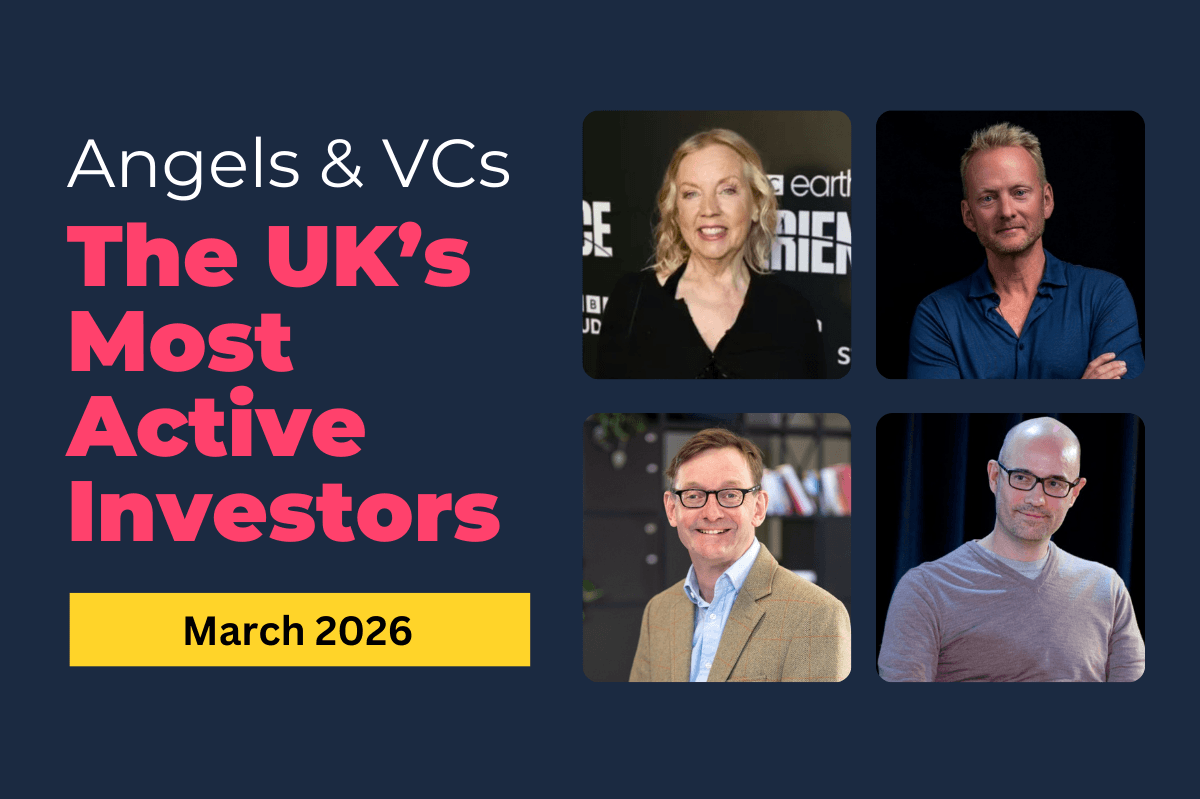

March 2026’s most active investors ranking reflects where UK capital was actually deployed in February 2026, spanning pre-seed, seed and growth rounds.
The analysis is based on Startupmag’s investor database, tracking live investment activity across thousands of UK angel investors, venture capital firms and corporate investment arms.
Across angels, venture capital and corporate sleeves the month reveals a layered financing stack. High-volume early cheques in AI and fintech continue to originate at pre-seed and seed, while institutional capital concentrates in the £3m to £15m band and extends selectively into £20m-plus growth rounds. Healthtech, energy and proptech appear as secondary but consistent corridors alongside platform software and infrastructure-led AI.
- Angels clustered at pre-seed and seed, typically operating within the £200k to £4m band and bringing operator credibility and signalling power.
- VC firms provided the scaling ladder, deploying capital from structured seed rounds through £3m to £15m mid-stage allocations and into £20m-plus internationalisation rounds.
- Mission-led and regional vehicles continued to originate and de-risk opportunities, feeding follow-on investors with validated early traction.
These dynamics point to a constructive but selective market. Early experimentation remains high, particularly in AI and fintech, but capital is increasingly concentrated into companies demonstrating commercialisation pathways and global scalability.
Angel investors: seed and pre-seed focus, operator angels in mid-to-large AI tickets
Charlie Songhurst, Chris Adelsbach, Stan Boland, Deborah Meaden and Gary Neville were the most visible angel investors in February 2026. Activity clustered in AI and healthtech, with a handful of consumer sustainability bets. Songhurst and Boland featured in heavyweight AI and deep-tech rounds, Adelsbach showed up in early-stage healthtech, and Meaden and Neville acted as public-figure backers of a consumer skincare start-up. The mix of operator angels and celebrity investors gave the month a dual character, combining conviction-led technical tickets with signal-driven consumer cheques. Overall, these patterns indicate UK angel activity is clustering where capital intensity meets demonstrable product-market fit, particularly in AI and healthtech.
Each angel displayed a distinctive pattern. Charlie Songhurst participated in larger, conviction-led AI and systems rounds such as Callosum (£7.5m) and the multi-million dollar financing of Seamflow (£3.3m), placing him in the £3m–£10m band and above for growth-stage deals. Stan Boland, with a deep-tech founder background, joined similar AI systems financings, exemplified by his involvement in Callosum (£7.5m). Chris Adelsbach operated at the earlier end of the spectrum, backing pre-seed healthtech like Tetra AI (£450k) in the c.£300k–£800k band, while Deborah Meaden and Gary Neville acted as public-facing consumer angels in small pre-seed rounds such as My Skin Feels (£50k). All amounts referenced are the reported round sizes, not the individual angel cheque.
Comparatively, public-figure angels such as Deborah Meaden and Gary Neville tend to back consumer and sustainability pre-seed opportunities with small, visibility-driven rounds. Operator and founder angels like Stan Boland and Charlie Songhurst appear in higher-capacity AI and infrastructure financings that sit in mid-to-large round bands and act as de-risking signals for VCs. Prolific fintech and operator angels such as Chris Adelsbach are more active around the classic seed and pre-seed ticket bands, supporting product development and early pilots that attract follow-on capital. These behaviours complement traditional seed and VC activity by providing both early validation and the technical credibility needed to scale into larger rounds. For founders the takeaway is clear: AI and healthtech entrepreneurs can secure momentum and follow-on-friendly capital from experienced operator angels, while consumer founders may win quicker visibility and retail traction through celebrity-led small rounds.
Venture capital firms: pre-seed to growth across AI, SaaS and fintech
| Venture Capital Firms | February Investments | Investment Sector | Location | Funding Round | Contact Details |
|---|---|---|---|---|---|
Dataline Labs (£750,000, AI) Decima2 (£480,000, Martech) Fulfilment.com (£4,000,000, Supply Chain) Made With Intent (£2,400,000, Ecommerce) |  Stamford | ||||
Bound ($245,000,000, Fintech) tem ($75,000,000, Energy) Kinfolk (£7,000,000, HRtech) | London | ||||
 Balderton Capital(more info 🔒) Balderton Capital is a venture capital firm focusing primarily on technolog... | Lawhive ($60,000,000, Legaltech) Mozart AI ($6,000,000, AI) Wayve ($1,500,000, AI) | London | |||
 Begin Capital(more info 🔒) Begin Capital is a London-based early-stage venture capital fund that backs... | AppFactor ($4,000,000, AI) SurrealDB (£17,000,000, AI) Dwelly (£69,000,000, Proptech) | London | |||
Mozart AI ($6,000,000, AI) Electric Twin (£10,000,000, Martech) Made With Intent (£2,400,000, Ecommerce) | London |

Haatch and AlbionVC emerged as the busiest backers in February, with Balderton, Begin Capital and Mercuri also recording multiple transactions. Deal flow was dominated by AI and SaaS, while fintech, energy and proptech saw strong activity. Martech and ecommerce formed a visible cohort, and HRtech and supply-chain automation also featured. Non-traditional models appeared alongside pure VC, notably British Business Bank co-investment and NPIF-backed vehicles that are supporting seed and regional rounds. Taken together, these flows point to a healthy UK funnel in which heavy seed and early B2B SaaS/AI activity is translating into larger, sector-specific follow-on rounds.
Each firm displayed a distinctive participation pattern. Haatch continued its pre-seed and seed focus, joining sub-£1m rounds such as Dataline Labs (£750k) and Decima2 (£480k), while also taking part in larger seed deals like Made With Intent (£2.4m; in the £300k–£3m band) and Fulfilment.com (£4m; in the £3m–£15m band). AlbionVC operated across Series A into growth, backing mid-market and growth rounds such as Kinfolk (£7m; £3m–£15m) and tem (£55m; £20m+), and supporting fintech scale-ups like Bound (circa £17.9m). Balderton pushed into headline growth tickets with Lawhive (£43.9m; £20m+) while still seeding category bets such as Mozart AI (£4.4m). Begin Capital and Mercuri showed seed-to-A agility — Begin in SurrealDB (£17m) and Dwelly (£69m; £20m+), Mercuri in Mozart AI (£4.4m) and Electric Twin (£10m; £3m–£15m) alongside smaller seed stakes.
The month underlined how seed, mid-stage and growth investors perform complementary functions in the UK ecosystem. Seed specialists sharpen product-market fit and founder sales motion for AI and SaaS companies. Mid-stage backers scale those models into commercial markets such as energy, fintech and proptech. Growth investors supply the large tickets needed for national and international expansion. Regional and mission-led vehicles such as NPIF and the British Business Bank act as important de-risking partners, broadening geographic reach and strengthening the pipeline. Corporate investors and CVCs typically fit into this architecture by seeking industry adjacency, R&D alignment, regulatory or clinical expertise and infrastructure-scale commitments that can accelerate commercialisation.
Corporate venture capital: less prominent in this month’s summaries
| Corporate Venture Capital Firms | February Investments | Investment Sector | Location | Funding Round | Contact Details |
|---|---|---|---|---|---|
Toyo (£3,000,000, AI) Wayve ($1,500,000, AI) | |||||
Wayve ($1,500,000, AI) | |||||
Tim Vaughan Racing (£540,000, Greentech) |

Corporate strategic investors were noticeably less prominent in February’s activity. While they usually serve as industry-adjacent partners at later validation and scale stages, their presence in the month’s summaries was muted. That said, corporate investors remain logical partners where strategic adjacency, R&D alignment or infrastructure commitments are required to accelerate commercialisation.
February reinforced a familiar UK pattern: AI, SaaS and healthtech drew the most attention, with a healthy seed funnel translating into larger, sector-specific follow-ons. Investor roles were distinct and complementary — operator angels supplied technical credibility and mid-to-large conviction cheques while public-figure backers provided visibility and quick consumer traction. VCs plugged gaps from seed through growth, converting early product validation into commercial scale and deploying mission-led vehicles to broaden the pipeline. Corporate investors were less prominent in the month’s summaries but remain logical partners at later validation and scale stages, offering strategic adjacency and infrastructure support. For founders the pragmatic takeaway is clear: match capital to need — use experienced angels to de-risk product and attract follow-on VC, rely on seed specialists to sharpen go-to-market, and time engagement with regional, mission or corporate partners as you prepare to scale.
Click here for a full list of 7,526+ startup investors in the UK