December’s Top Investors: The Angels and VCs Backing the Fastest Growing UK Startups
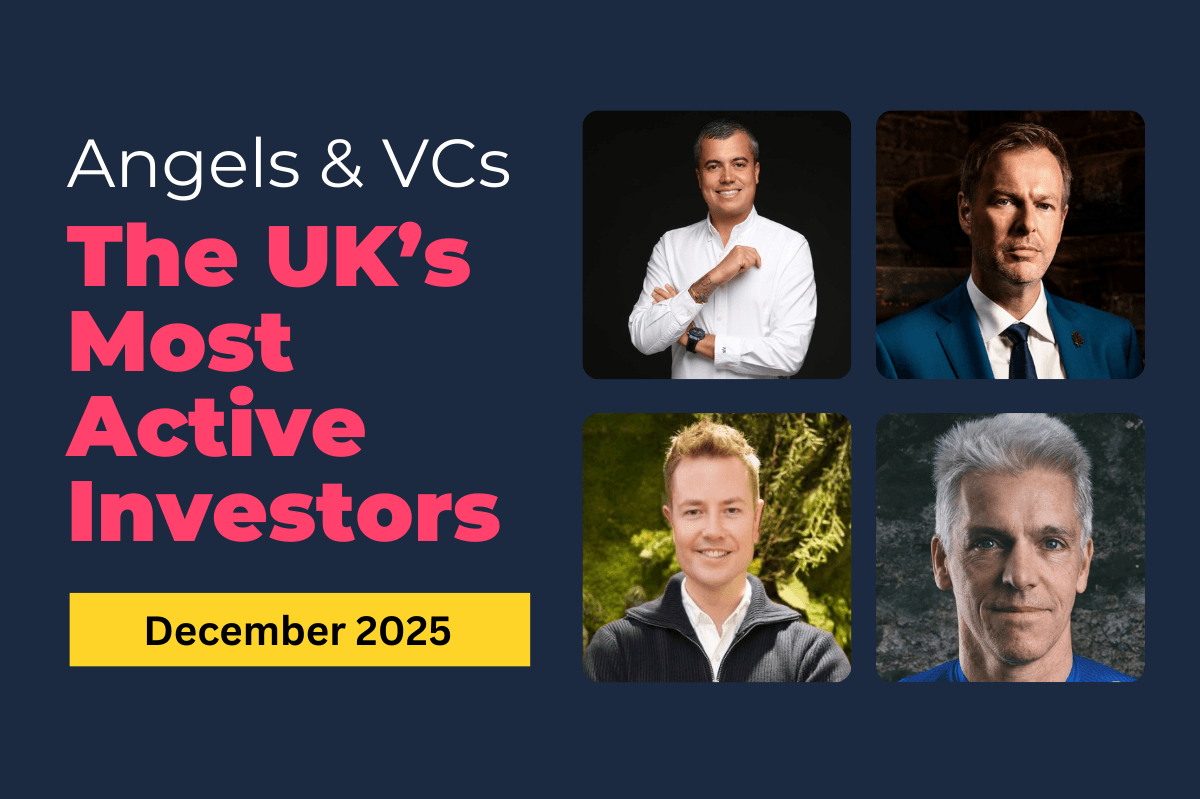

December’s ranking reflects the investors most active in November, based on our tracking of 63 funded UK startups and the activity of 37 angel investors, 152 VC firms and 32 institutional and corporate backers. November’s funding landscape was layered and purposeful, with angels, venture capital and corporates concentrating dealflow in AI, healthtech and fintech while maintaining steady interest in cyber, regtech and industrial applications such as mobility and energy.
Angels clustered around seed and early tickets in the sub-£1m to around £3m range, providing visibility and specialist validation. Venture capital acted as the mid-market bridge from pre-seed into Series A and growth rounds, defined by clear cheque bands and deliberate portfolio construction. Corporate and institutional investors deployed strategic, often larger cheques into late-stage clinical and industrial opportunities, often using structured finance or debt-like mechanisms to accelerate commercial adoption.
The mood across the market was constructive and disciplined. A healthy seed pipeline and studio-led dealflow are producing investable proof points, regional and mission-led funds are reducing risk for scale-ups, and corporate and structured capital remain ready to finance the costliest inflection points.
Angel investors powering early fintech, regtech and AI rounds
This November the most visible individual angels in our dataset were Peter Jones, Dan Cobley, Amar Shah, Pierre Decote and Keith Grose. Their activity highlights three dominant themes: fintech and regtech, AI and healthtech, and a smaller strand of Web3 and consumer travel deals. Peter Jones stands out as a public figure, backing Snowball on Dragons’ Den while taking part in a large Web3 round for Gener8. Taken together, the mix shows UK angels balancing publicity-driven consumer stakes with sector specialist bets that reinforce seed and early-stage ecosystems.
Patterns between these individuals are distinct:
-
Peter Jones’s activity ranges from a small consumer-accessibility investment in Snowball (£80,000) to a headline Web3 round in Gener8 (£5.1m).
-
Dan Cobley and Keith Grose skew towards finance and regtech, joining rounds such as Adclear (£2.1m), Unbox (£1.2m) and Yavrio (£1.9m). They also have prior fintech deals such as Incredible (~$1m) and typically cluster in the c.£1m–£3m band.
-
By contrast Pierre Decote and Amar Shah act as thematic AI and cyber/health specialists, participating in smaller Alfa rounds (c.£495k) and FALKIN (£1.6m) as well as larger technology and healthtech raises such as Agemo (£3.2m) and Emm (£6.8m).
All amounts cited are the size of the funding rounds, not the angels’ individual cheques.
Public-figure angels such as Jones tend to combine headline-making consumer plays with occasional large Web3 deals. Operator and finance-oriented angels like Cobley and Grose concentrate on seed and early-stage fintech and regtech rounds in the £1m–£3m band. Thematic AI and cyber investors such as Shah and Decote are more likely to participate in higher-value seed and early series rounds, helping to validate technically complex propositions before venture capital firms commit.
These patterns show angels clustering around clear sector lanes and ticket bands, supplying both publicity and technical credibility that de-risk early stages.
For founders the implication is straightforward: seek public-profile investors to generate consumer momentum, but prioritise sector specialists when you need deeper validation and the follow-on signal that accelerates VC interest.
VC firms bridging early innovation into mid-market scale
| Venture Capital Firms | November Investments | Investment Sector | Location | Funding Round | Contact Details |
|---|---|---|---|---|---|
 Fuel Ventures(more info 🔒) Fuel Ventures is a venture capital firm that focuses on backing ambitious t... | Sencillo (£350,000, Fintech) Intelligent Core (£2,000,000, SaaS) Tyten (£750,000, Proptech) |  London | |||
Vigilant AI (£585,000, AI) FALKIN (£1,600,000, Cyber security) Adclear (£2,100,000, Regtech) | Stamford | ||||
 Northern Powerhouse Investment Fund II(more info 🔒) The Northern Powerhouse Investment Fund (NPIF) focuses on providing finance... | HR Guru (£100,000, HRtech) Freeklime (£150,000, Healthtech) Uniphy (£3,000,000, Hardware) | Sheffield | |||
AI Score ($1,000,000, AI) StirlingX ($11,000,000, Drones) | London | ||||
Fit Collective (£3,000,000, Ecommerce) Scripta Therapeutics ($12,000,000, Biotech) | London | ||||
T-Therapeutics ($32,000,000, Biotech) TMT ID (£30,000,000, Cyber security) | London |


Haatch, Fuel Ventures, AlbionVC, BGF, the Northern Powerhouse Investment Fund II and GALLOS Technologies emerged as the most active backers in November 2025. Activity clustered around AI and healthtech, with robust interest in cyber and regtech, fintech, greentech and a steady stream of SaaS deals. Specialist vehicles are clearly present: regional and mission-led programmes such as NPIF II and British Business Bank co-invest platforms sit alongside non-traditional models like the GALLOS venture studio. Together these flows reveal a layered UK market in which early technical innovation and sector incumbency attract follow-on capital and patient, public-backed investment.
-
Fuel Ventures moves across seed to small growth rounds, appearing in sub-£1m pre-seed tickets such as Sencillo (£350k) and Tyten (£750k), participating in £0.5m–£2m deals like Intelligent Core (£2m) and featuring in larger £3m–£15m financings exemplified by Tessaract (£4.6m).
-
Haatch follows an early-stage playbook with frequent £200k–£800k and £0.5m–£2m rounds, illustrated by Vigilant AI (£585k), FALKIN (£1.6m) and Adclear (£2.1m), and will stretch to Series A-sized tickets as companies scale.
-
NPIF II blends micro-loans and grants with growth equity, shown by HR Guru (£100k), Feasibly (£200k) and Uniphy (£3m).
-
AlbionVC and BGF dominate the mid-to-growth bands, leading many £3m–£15m rounds including Mondra (£10m) and Scripta/Maxion linked financings, and stepping into £20m+ deals such as Cyted Health (£33m) and T-Therapeutics (circa $32m).
-
GALLOS, operating as a venture studio, spins out pre-seed projects like AI Score ($1m) and shepherds them into larger seed and extension rounds such as StirlingX ($11m).
The market dynamic is clear. Early-stage investors and studios seed technical innovation and product-market fit with frequent sub-£2m rounds. Mid-stage VCs specialise in scaling those businesses through the £3m–£15m band, while growth-oriented funds and public-backed vehicles provide double-digit million capital and patient minority stakes.
Regional and mission-led funds play a connective role by underwriting local scaling and de-risking later participation, and venture studios increase dealflow by incubating teams and technologies that feed the seed pipeline. These layers interact cohesively: early innovation generates investable proof points, mid-market players commercialise those opportunities, and large-scale growth capital is ready to support widescale expansion.
Corporate venture investors deploying strategic capital into clinical and industrial growth
| Corporate Venture Capital Firms | November Investments | Investment Sector | Location | Funding Round | Contact Details |
|---|---|---|---|---|---|
 Novartis Venture Fund(more info 🔒) Novartis is a global pharmaceutical company headquartered in Switzerland, k... | Artios ($115,000,000, Biotech) | Basel, Switzerland | |||
PhysicsX ($20,000,000, AI) | Munich, Germany | ||||
 Deutsche Bank(more info 🔒) Deutsche Bank is one of Europe’s largest financial institutions offering co... | Zilch ($175,000,000, Fintech) | Frankfurt, Germany | |||
 Porsche Ventures(more info 🔒) Porsche is a German automotive manufacturer known for high-performance spor... | Laka (£6,500,000, Insurtech) | Stuttgart, Germany | |||
 Pfizer Ventures(more info 🔒) Pfizer is a leading biopharmaceutical company focused on vaccines and treat... | Artios ($115,000,000, Biotech) | NYC, US | |||
 Sanofi Ventures(more info 🔒) Sanofi is a multinational healthcare company specialising in pharmaceutical... | T-Therapeutics ($32,000,000, Biotech) | Paris, France |

November’s corporate activity was driven by a familiar coalition of pharma CVCs and industrial strategics. Novartis Venture Fund, Pfizer Ventures and Sanofi Ventures dominated the biotech and healthtech cluster, while Siemens pushed industrial AI and mobility and energy plays. Financial players moved into fintech and insurtech, with Deutsche Bank arranging structured financing for payments and Porsche Ventures providing venture-debt style support into micromobility insurance. The month’s deals coalesced into three clear clusters: biotech and clinical programmes, industrial AI with mobility and energy infrastructure, and fintech with structured finance. This reveals a corporate playbook that mixes R&D protection, industrial adjacency and direct scale-up support.
The pattern across investors reads as purposeful differentiation rather than scattergun deployment.
-
Pharma CVCs favoured late-stage clinical exposure, exemplified by Novartis and Pfizer’s participation in Artios’s oversubscribed Series D, an upper-clinical range financing of around $115m.
-
Sanofi’s backing of T-Therapeutics was a mid-stage Series A extension of roughly $32m, underscoring appetite to bridge preclinical programmes into the clinic. Siemens took a strategic mid-market tech cheque with a mid-stage extension into PhysicsX’s Series B to accelerate industrial software adoption.
-
At the same time, Deutsche Bank led a large mixed debt-and-equity package for Zilch that leaned on securitisation, and Porsche Ventures deployed a support-and-debt tier facility into Laka’s micromobility insurance growth.
Viewed comparatively, pharma CVCs act as patient, science-focused guardians that elevate promising programmes into costly clinical inflection points, while industrial corporates prefer platform and application bets that accelerate adoption in engineering, energy and mobility.
Banks and structured-finance teams supply scale via securitisations and mixed capital packages that suit consumer fintechs, whereas insurer-linked units and corporate treasuries lean towards debt-like instruments or insurance-adjacent stakes to manage risk. Together these layers, early scientific bets, mid-stage clinical programmes, industrial AI adoption and structured bank financing, form a stacked ecosystem across the UK and Europe in which corporate balance sheets both protect long-term R&D value and provide the commercial scaffolding that helps scaleups move from lab or pilot to market.
Across the three cohorts a coherent ecosystem logic emerges. Convergence around AI, healthtech and fintech underpins a staged funding continuum in which angels and studios supply early publicity and technical validation, venture capital commercialises and scales proofs, and corporate and structured-finance players provide patient, strategic capital for clinical trials or industrial deployment.
Angels contribute headline-making consumer stakes and thematic expertise that de-risk nascent propositions. VCs supply layered seed-to-growth finance and the regional or mission-led glue that turns proof points into scale. Corporates and banks bring later-stage, sector-specific capital and deal structures for market entry and large capital requirements.
For founders the composite picture is actionable: match your ask to the investor role you need, use public-profile or specialist angels to create momentum and technical credibility early, lean on VCs and mission funds to scale commercial traction, and engage corporate or structured-finance partners when strategic routes to market or large, patient capital are required.
Click here for a full list of 7,526+ startup investors in the UK