UK Startup Funding Report: £930.4m raised across AI, Healthtech and Construction (27 Apr–1 May 2026).

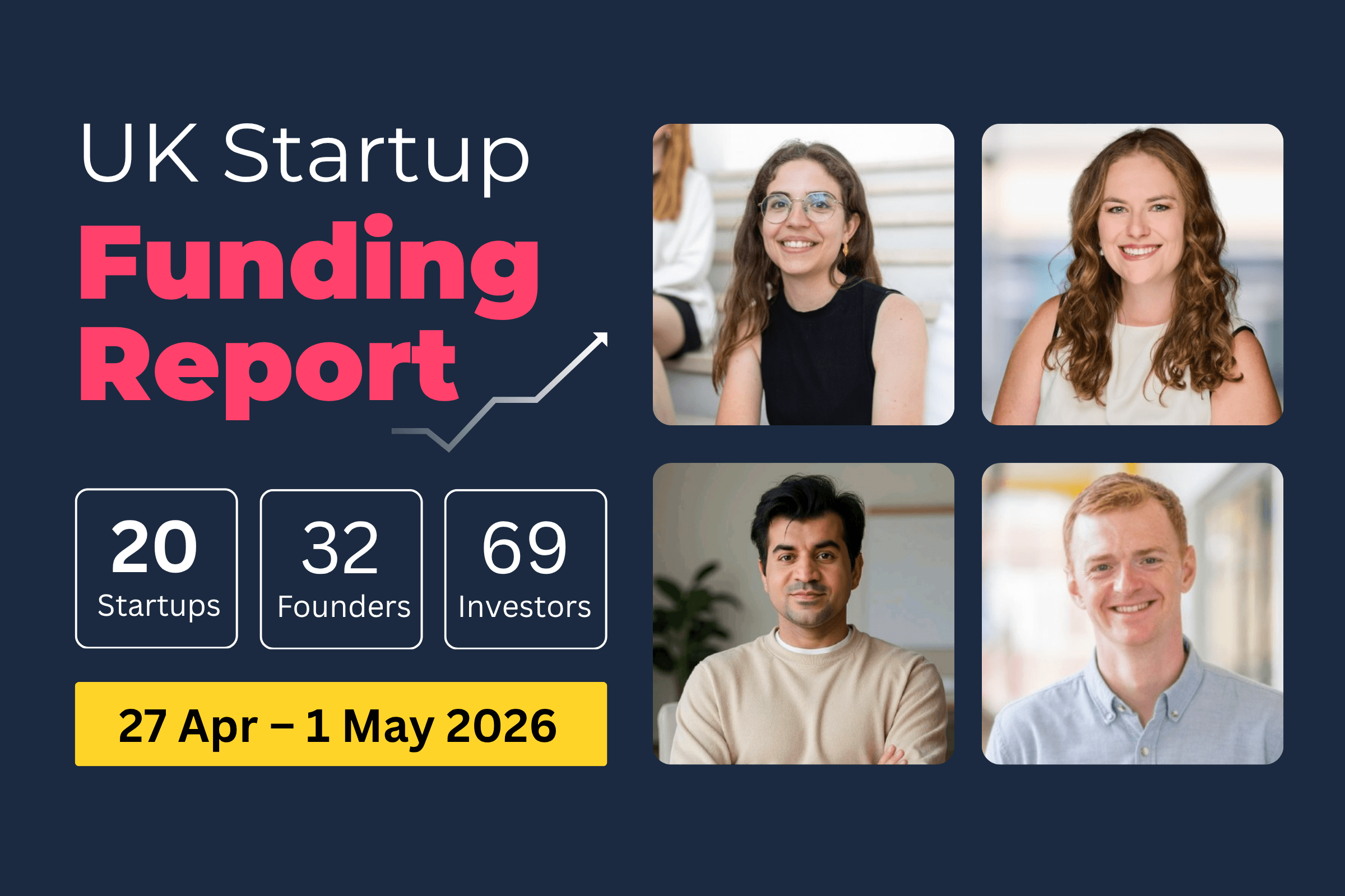
It's Friday, 1 May, and this is your UK Startup Funding Report.
This week saw a mix of landmark AI financings and steady support for healthtech and construction innovators, with deals ranging from seed rounds to large debt facilities. The announcements highlight investor appetite for deep tech, clinical devices and automation in the built environment.
AI investment splits between foundational research and productised tools
Foundational and applied AI deals dominated the week, with large, research‑led wagers sitting alongside more immediate SaaS plays. That divergence matters: investors are simultaneously underwriting long‑term platform work and backing near‑term commercial products that can generate revenue today.
Headline activity included Ineffable Intelligence's £800 million seed to build a reinforcement‑learning "superlearner" for scientific discovery, alongside smaller rounds for applied tools. Dex raised £4 million to expand an AI‑powered hiring product into the US, and Marloo closed £7.38 million to scale an AI assistant for financial advisers, automating paperwork, compliance and client context.
Taken together, these rounds show capital flowing into both foundational research and industry‑specific deployments, with London a clear hub for the activity. The key question for the market is whether investors will increasingly channel foundational capital into practical deployments or continue to treat the two strategies as separate bets.
This week's AI & Machine Learning deals:
Ineffable Intelligence announced a headline £800 million seed to build a reinforcement‑learning “superlearner” aimed at scientific discovery. The London‑based team will use the cash to scale compute and research, signalling major capital flowing into foundational AI work in the UK.
Dex raised £4 million in a seed round to expand its AI‑powered hiring product and enter the US market. The platform acts as a talent agent for candidates and will use the funds to grow operations in New York and San Francisco.
Marloo closed a £7.38 million seed to scale its AI assistant for financial advisers, automating paperwork, compliance and client context. The company will use the capital to deepen integrations, grow distribution and expand its product for regulated advisory teams.
Healthtech deals emphasise clinical validation and device scale‑up
Clinical imaging, wearable sensing and data‑led diagnostics attracted capital this week, with investors favouring university spinouts and regulated, clinically focused products. That orientation reflects the industry's need for clinical validation and regulatory progress as prerequisites for adoption and exit.
Notable rounds included Hypervision Surgical's £17 million Series A to commercialise its hyperspectral imaging platform and accelerate clinical deployments of HYPERSNAP, and Cerca Magnetics' £3.8 million to advance a wearable brain scanner based on quantum sensors towards clinical approval and scaled manufacturing. PlaqueTec raised £3.7 million to expand BioCarta, an intracoronary proteomic data platform, while auryx secured £1.5 million to develop earbud‑based continuous health monitoring.
These deals demonstrate capital flowing into both device and data plays, with regional clusters from Cambridge to Nottingham developing different specialisms. Investors appear prepared to fund the longer path to clinical adoption when the technologies address clear hospital and diagnostic needs.
This week's Healthtech & Biotech deals:
Hypervision Surgical raised £17 million in an oversubscribed Series A to commercialise its hyperspectral imaging platform for surgery. The funds will accelerate clinical deployments of HYPERSNAP, next‑generation sensors and cloud AI analytics to reduce intraoperative complications.
Cerca Magnetics raised £3.8 million to advance a wearable brain scanner based on quantum sensors towards clinical approval and scale manufacturing for hospital use. The funding will support regulatory work and wider roll‑out for applications such as epilepsy and paediatric imaging.
PlaqueTec secured £3.7 million in a seed round from existing investors to expand BioCarta, its intracoronary proteomic data platform. The capital will fund further sample collection and analysis to support drug development partnerships.
auryx raised £1.5 million to develop a platform that turns earbud microphones into continuous health monitors using acoustic analytics. The seed will fund model development, hardware integration and commercial partnerships to move acoustic diagnostics into consumer devices.
Deep tech funding targets scale and export potential
Capital flowed to physical‑world deep tech this week, from photonics and robotics to autonomous vessels and space optics. Investors emphasised the ability to move from prototype to repeatable manufacturing, seeing scale and export potential as routes to industrial contracts and revenue.
All3 closed a £19 million growth round to deploy robotic construction systems and scale integrated robotics for projects in Germany. Cnuic raised £2.2 million to commercialise a photolithography device for reconfigurable photonic chip production. Online Oceans secured £4 million to scale manufacturing of solar‑powered autonomous surface vessels and its fleet software, while Spaceflux raised £9 million and was selected to supply optical systems for a Canadian space surveillance programme.
The varying round sizes reflect different capital intensities across tooling, optics and maritime hardware. Several companies highlighted export or international programme work as a path to scale, signalling continued investor support for firms that can translate prototypes into repeatable hardware production.
This week's Deep Tech & Hardware (Space, Photonics, Robotics, Construction, Autonomy) deals:
All3 closed a £19 million growth round to deploy robotic construction systems, design automation and robotic factories for projects in Germany. The capital will advance R&D and help the company scale integrated robotics to tackle housing delivery bottlenecks.
Cnuic raised £2.2 million to commercialise a prototype photolithography device for reconfigurable photonic chip production. The funds will help translate the prototype into higher‑volume manufacturing for photonics used in data centres, AI hardware and AR/VR.
Online Oceans closed a £4 million seed to scale manufacturing of solar‑powered autonomous surface vessels and its fleet software for maritime surveillance. The capital will support deployments and help the company deliver persistent coverage for defence and commercial customers.
Spaceflux raised £9 million and was selected to supply optical systems for a Canadian space surveillance programme led by MDA. The deal pairs UK space sensing capability with an international prime and should help the company scale ground‑based observatory hardware.
Greentech: infrastructure finance meets climate software
This week’s greentech activity ranged from bank‑backed energy project finance to early‑stage climate software and mobility. The variety of financing approaches — from debt to angel rounds — reflects the sector's breadth, spanning asset‑heavy projects and product‑led startups.
Enviromena arranged a bank‑backed package totalling £825,000 to accelerate a UK solar pipeline into construction. TrackZero closed £500,000 in pre‑seed funding from local angels to enhance AI capabilities for supply‑chain emissions measurement. Forest raised £27 million in a Series B extension to expand its shared e‑bike service across London, and Kigen secured £10 million in growth debt to broaden its GSMA‑certified eSIM and device security services.
The deals underline a split between asset finance for infrastructure and early‑stage product work in climate software. Mobility and asset‑backed models continue to attract larger cheques, while pre‑seed climate tools often rely on local angel networks. Expect a continued mix of instruments as companies scale operationally.
This week's Greentech, Energy & Platforms / Consumer & Services deals:
Enviromena arranged a bank‑backed financing package totalling £825,000 to accelerate delivery of a UK solar pipeline and move projects from development into construction. The flexible facility combines committed capital and an accordion to support multiple project stages.
TrackZero closed £500,000 in pre‑seed funding from local angels to boost its AI capabilities for supply‑chain emissions measurement. The product focuses on supplier engagement and producing reporting aligned with recognised carbon standards.
Forest raised £27 million in a Series B extension to scale its shared e‑bike service across London and invest in parking bays, chargers and app improvements. The funding mixes equity and asset‑backed finance and positions the operator to expand its infrastructure and improve fleet reliability.
Kigen secured £10 million in growth debt from Salica Investments to expand its GSMA‑certified eSIM and device lifecycle security services across the UK, EU and US. The deal underscores demand for lifecycle security as regulation tightens around connected devices.
🎧 That's this week's Startupmag Weekly Briefing.
See you next Friday for another look at the UK startup scene.