UK Startup Funding Report: £1133.4m raised across Fintech, AI and Biotech (11–15 May 2026).

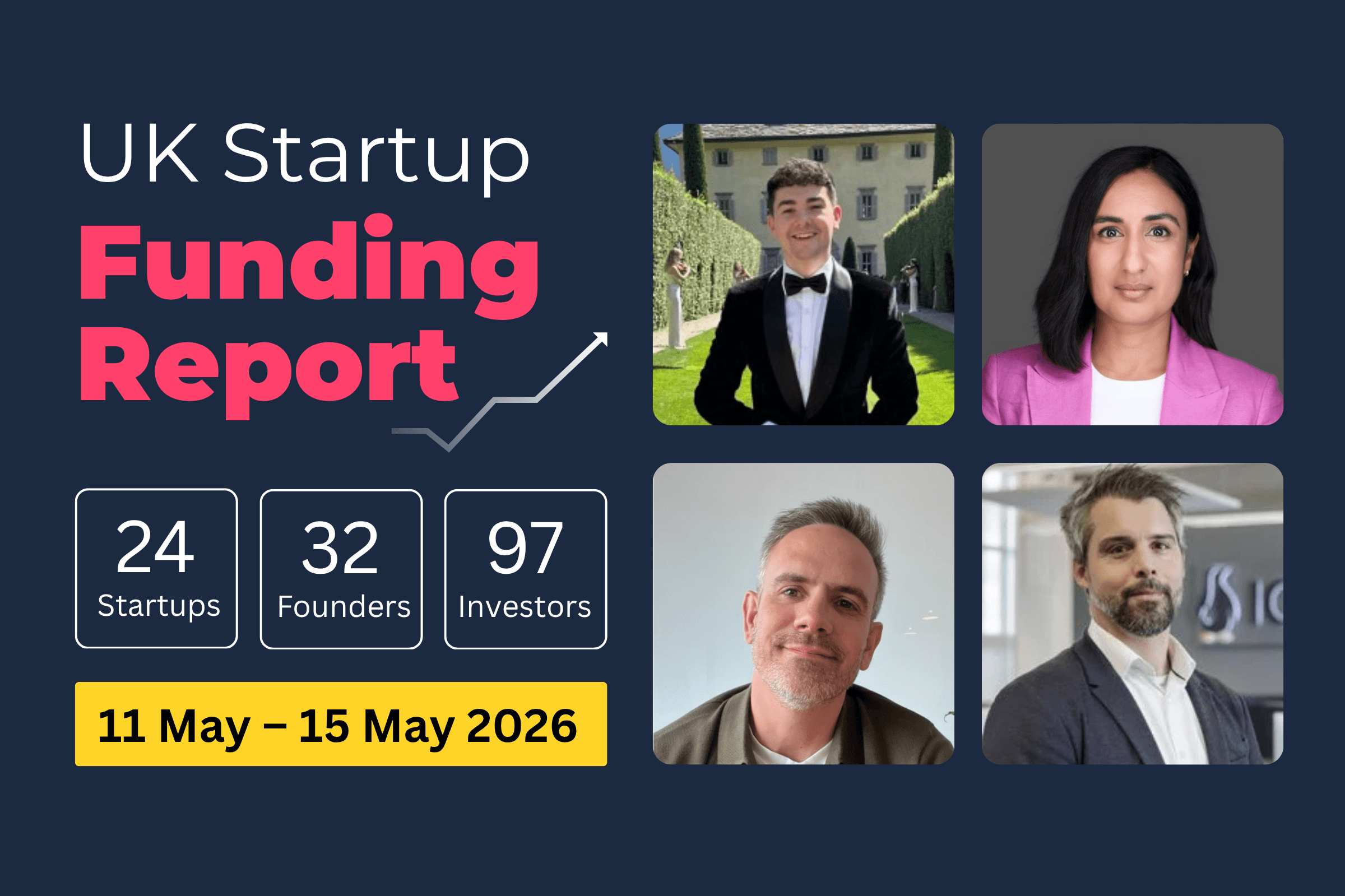
It's Friday, 15 May, and this is your UK Startup Funding Report.
UK startups raised a combined £1133.4M across 11–15 May 2026, led by large AI and biotech rounds alongside active fintech deals. The week saw capital flow into AI infrastructure, model-focused hardware and financial-platform scale-ups.
AI investment moves into infrastructure and safety
Startups building model infrastructure, specialised inference hardware, AI safety tools and workforce platforms attracted the bulk of investor attention this week. Funding is flowing into both compute and software layers as companies push to put models into production and to manage the operational risks that follow. That combination signals a shift beyond research and into the parts of the stack enterprise customers actually buy.
Several large rounds underline the point. Nscale secured about £581.14 million in structured financing to underwrite a major expansion of its Narvik AI data-centre campus and GPU hosting capacity. Fractile raised £160 million to accelerate delivery of inference chips and systems designed to reduce latency and boost memory bandwidth for long-context workloads. At the smaller end, Multiverse took £52 million to expand its skills-mapping platform across Europe, while White Circle closed £8 million to develop a single-API platform for monitoring deployed AI behaviour in real time.
The pattern is clear: large pools of capital are backing heavy infrastructure plays alongside the tools that make models safe and usable. It is notable that structured lenders and export finance bodies are involved in the biggest deals, while smaller rounds target observability and workforce enablement as enterprises operationalise AI.
This week's AI deals:
Nscale secured roughly £581.1m in structured financing to underwrite a major expansion of its Narvik AI data-centre campus and GPU hosting capacity. Lenders and export finance bodies provided the package, reflecting appetite for capital-intensive AI infrastructure rather than only software plays.
Fractile raised £160m to speed delivery of inference chips and systems that aim to reduce latency and boost memory bandwidth for long‑context AI workloads. The round highlights investor demand for specialised hardware to tackle inference bottlenecks as models scale.
Multiverse raised £52m to accelerate European expansion and develop its skills‑mapping platform for AI and digital training. The company says the capital will scale training products aimed at closing workforce capability gaps as organisations invest heavily in AI adoption.
White Circle secured £8m to develop a single‑API platform that monitors and controls deployed AI behaviour in real time. The team positions the product as enterprise-grade observability to catch hallucinations, prompt injections and model drift before they affect users.
Fintech backs infrastructure and on-chain compliance
Investors continued to fund companies modernising core financial plumbing and building on-chain compliance tools as digital assets edge into institutional use. Growth capital favours payments rails, issuer processing and analytics that help banks and exchanges manage tokenised assets, smoothing the path for real-time, regulated digital finance.
Notable rounds included Paymentology’s roughly £128.59 million raise to speed international expansion and product development for its cloud-native card-issuance platform, and Elliptic’s £88.66 million to broaden on-chain analytics and compliance services for banks, exchanges and regulators. Adfin secured about £13.23 million to scale an automated invoice-chasing and payments platform for SMEs using agentic AI workflows. ThatRound completed a pre-seed to build a language-model driven matching service for founders and investors; the amount was not disclosed.
The capital flow spans large strategic growth rounds and experimental early-stage bets. The clear trend is institutional demand for robust payments infrastructure and real-time blockchain risk monitoring as tokenised assets move toward mainstream adoption.
This week's Fintech deals:
Paymentology raised about £128.6m in growth capital to accelerate international expansion and product development for its cloud-native card-issuance platform. The funding, co-led by sector specialists, underlines continued investor interest in payments infrastructure that replaces legacy issuer processing.
Elliptic closed about £88.7m to expand its on‑chain analytics and compliance platform for banks, exchanges and regulators. The raise reflects rising demand for real‑time blockchain risk monitoring as institutions incorporate stablecoins and tokenised assets into core operations.
Adfin raised roughly £13.2m to expand its platform that automates invoice chasing and payments for SMEs using agentic AI workflows. The company says the capital will fund product expansion, hiring and moves toward end‑to‑end cashflow management.
ThatRound closed a pre‑seed round (amount not disclosed) from founder and angel participants to scale a language‑model driven matching platform that connects founders with investors. The service aims to replace cold outreach by matching on nuanced investor preferences and improving access to early‑stage capital.
Biotech funding: AI discovery sits alongside translational bets
This week’s biotech and healthtech activity mixed a blockbuster AI-driven drug-discovery round with smaller wet-lab and medtech raises. Investors are backing large, platform-scale AI approaches while also funding translational projects aimed at clinical and manufacturing readiness, reflecting appetite for both discovery velocity and downstream de-risking.
Isomorphic Labs raised about £1.5 billion to scale its IsoDDE AI drug-design engine and advance multiple programmes toward clinical trials. Elsewhere, Meatly secured £10.4 million to build a pilot facility and move cultivated meat from lab scale toward production readiness. Infex Therapeutics closed £4.3 million to advance RESP-X after a Phase 2a readout and to progress other programmes against resistant Gram-negative infections, and Scarlet Therapeutics raised a £3.2 million seed to accelerate development of lab-grown universal red blood cells.
The picture is one of concentration at the top and focused translational bets below: a large AI-first investment sits alongside regional projects advancing manufacturing, anti-infectives and engineered cell therapies, each addressing different points on the development pipeline.
This week's Biotech & Healthtech deals:
Isomorphic Labs raised £1.5bn to scale its IsoDDE AI drug‑design engine, advance multiple programmes toward clinical trials and expand hiring across AI and drug discovery. The round is a major endorsement of an AI‑first approach to designing candidate medicines at speed.
Meatly raised £10.4m to build a pilot facility and move cultivated meat work from lab scale toward production readiness. The cash will support process scale‑up, regulatory engagement and steps to de‑risk manufacturing.
Infex closed £4.3m to advance RESP‑X after a Phase 2a readout and to progress MET‑X and preclinical programmes tackling resistant Gram‑negative infections. The funding bridges clinical development steps for antibiotics-focused candidates addressing antimicrobial resistance.
Scarlet raised £3.2m seed to accelerate development of lab‑grown universal red blood cells and progress in‑vivo proof‑of‑concept work. The funds will support lead candidate selection, manufacturing development and regulatory engagement.
Greentech tackles data-centre energy and resilience
Hardware and energy companies addressing data-centre power, cooling and local generation attracted funding as compute demand rises. Investors are prioritising technologies that reduce carbon and water use or remove rare-earth dependencies, linking sustainability with operational resilience for cloud and AI infrastructure.
Iceotope raised about £19.23 million to accelerate precision liquid cooling for denser AI racks and high-performance computing systems, while H2CHP secured a £1.5 million seed to move a free-piston linear generator into pre-deployment testing for fuel-flexible, rare-earth-free local power in data centres, ports and microgrids.
The deals underline investor interest in decarbonisation and resilient power as compute scales up. Expect further capital to follow companies that can cut energy intensity while supporting higher rack power densities.
This week's Greentech & Infrastructure deals:
Iceotope raised about £19.2m to accelerate precision liquid cooling for denser AI racks and HPC systems. The funding targets product development, patent expansion and partner integrations as the industry shifts to higher rack power densities.
H2CHP raised £1.5m seed to move its free‑piston linear generator into pre‑deployment testing for fuel‑flexible local power. The technology targets resilient, rare‑earth‑free generation for data centres, ports and microgrids.
Regional tech: defence, live entertainment and edtech draw capital
A disparate set of defence hardware, immersive live-entertainment and edtech startups raised early-stage capital across the regions. The rounds reflect continued public and private support for regional manufacturing, creative touring products and niche SaaS tools, showing how funding can target both strategic capability and cultural export.
Rowden Technologies secured £25 million from the National Wealth Fund to expand UK production of sensing and secure communications hardware and to build a test facility in the West Midlands. Esk raised £2.6 million to adapt screen IP for touring live entertainment and to scale its in-house AV and media control systems for international touring. AskEd closed a £100,000 pre-seed to deploy voice AI for out-of-hours student recruitment and lead qualification in higher education.
These deals reveal a regional pattern: public funds and strategic investors backing manufacturing and defence capability, while smaller private rounds support creative and education technology. The variety suggests an ecosystem in which sovereignly minded investments and market-driven early-stage plays coexist.
This week's Other tech & deep‑tech deals:
Rowden secured £25m from the National Wealth Fund to expand UK production of sensing and secure communications hardware and to build a test facility in the West Midlands. The investment is framed as strategic support for sovereign capability and regional manufacturing growth.
Esk raised £2.6m to adapt screen IP for touring live, venue-based entertainment and to scale its in‑house AV and media control systems. The funding supports international touring and licensing of film and TV franchises into live shows.
AskEd raised £100,000 pre‑seed to deploy voice AI for out‑of‑hours student recruitment and lead‑qualification in higher education. The product answers enquiries in dozens of languages and integrates with CRM systems to improve conversion from international leads.
🎧 That's this week's Startupmag Weekly Briefing.
See you next Friday for another look at the UK startup scene.