UK Startup Funding Report: £196.4m raised across AI, Foodtech and Biotech (13–17 Apr 2026).

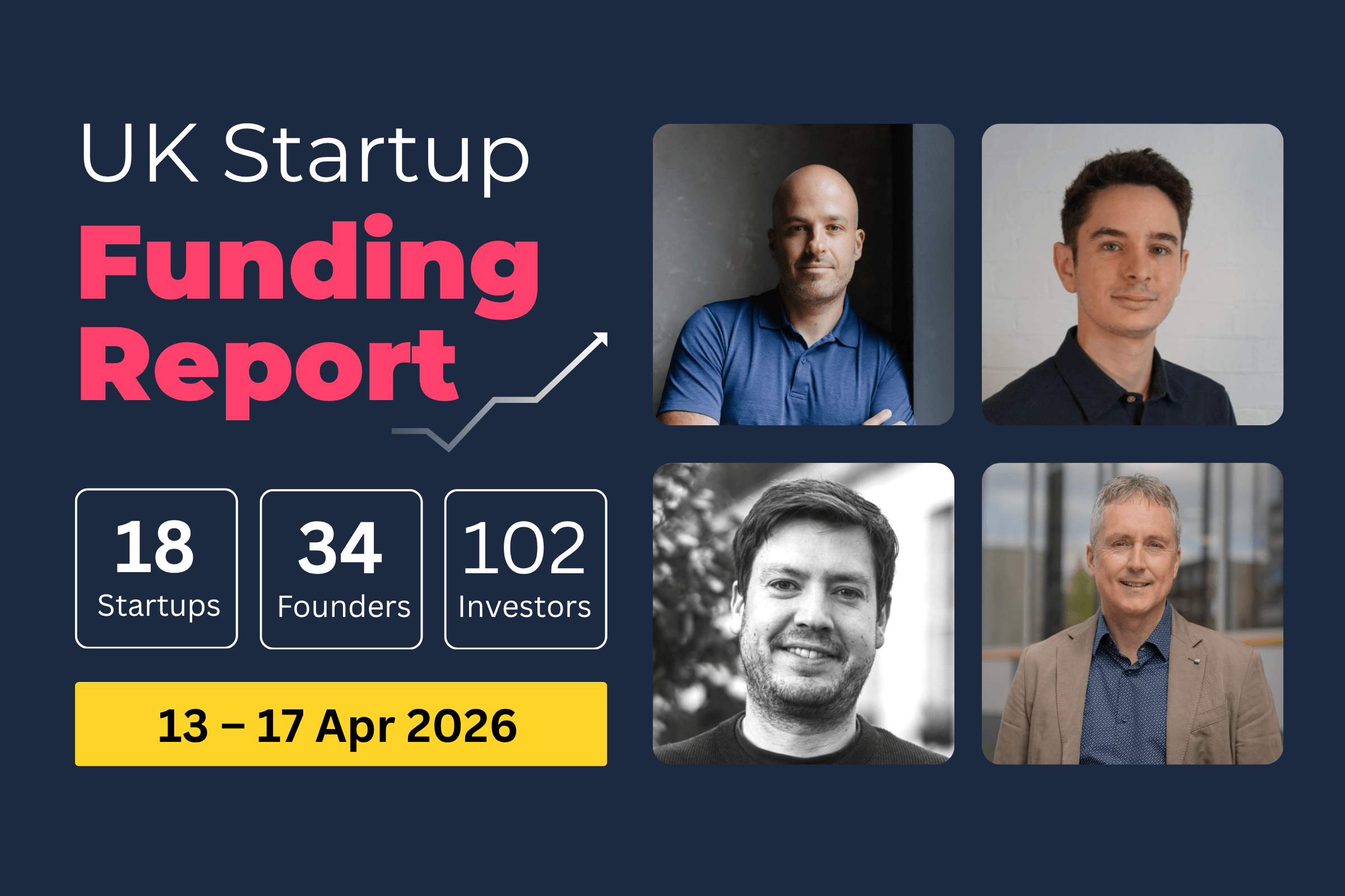
🎧 Prefer to listen? Play this week's Startupmag Briefing below:
It's Friday, 17 April, and this is your UK Startup Funding Report.
A busy week for UK startups saw strategic growth rounds across AI, foodtech and biotech, with a mix of commercial scale-ups and instrument and platform plays raising significant capital. Investors backed both hardware-enabled scale projects and AI-first software companies as firms moved from pilot to deployment.
AI and automation move into production
Startups are shifting foundation models, embodied AI and agent frameworks out of the lab and into everyday workflows, and investors are funding platforms that operationalise those prototypes. This week’s rounds span mobility, education, enterprise and drug discovery, reflecting a preference for teams that can deliver production integrations rather than only research breakthroughs.
Wayve raised £44.22 million to accelerate integration of its portable Wayve AI Driver across multiple vehicle compute platforms; funding from major silicon partners will support engineering work and production deployments for ADAS and robotaxi programmes. Gizmo closed £16.22 million to scale an AI study platform aimed at US colleges, using the cash to deepen features that turn notes and documents into adaptive flashcards and quizzes for its reported 13 million users. Lua secured £4.29 million to build an operating system for human–agent workforces, financing product development and partner‑led deployments that let teams manage automated agents alongside staff. Helical raised £7.37 million to commercialise a virtual AI lab that converts biological foundation models into governed, auditable in‑silico discovery workflows for pharma R&D.
Taken together, the deals suggest investors favour tooling that embeds AI into operational stacks rather than one‑off models. There is growing strategic interest from hardware and silicon partners in software‑first autonomy, and early cross‑regional support for firms that promise auditable agent frameworks.
This week's AI & Automation deals:
Wayve raised £44.22m in a growth extension of its Series D to speed integration of its portable Wayve AI Driver across multiple vehicle compute platforms. The funding from major silicon players will support engineering work and production deployments for ADAS and robotaxi programmes. The round signals growing strategic interest in software-first autonomy from hardware suppliers.
Gizmo closed a £16.22m Series A to scale its AI study platform as it targets US colleges and grows its engineering and AI teams. The startup will use the cash to deepen product features that convert notes and documents into adaptive flashcards and quizzes for its 13 million users. The round reflects investor interest in consumer learning tools that combine high engagement with measurable retention.
Lua closed £4.29m to build an operating system for human–agent workforces, letting teams deploy and manage automated agents alongside staff. The round will support product development and partner-led deployments, emphasising owner‑controlled agents rather than black‑box platforms. Early traction and cross‑regional investor interest point to demand for tooling that operationalises agent frameworks.
Helical raised £7.37m to commercialise a virtual AI lab that turns biological foundation models into reproducible, decision‑ready in‑silico discovery workflows. The capital will help deliver governed workflows for pharma use cases and expand deployments beyond pilots. Investors backed the company’s focus on operational tooling that helps teams act on model outputs with scientific auditability.
Fintech readies rails for agent‑driven payments
Investors continue to favour SME banking, embedded lending and new payment rails designed with AI transactions in mind. This week’s activity highlights an effort to combine payments, treasury and credit while preparing infrastructure for autonomous, agent‑driven financial flows.
Wamo raised £8.71 million in a Series A to expand in Italy and the Nordics and to roll out AI‑driven embedded lending across its multi‑currency business accounts; the capital will fund product development and market expansion. Ralio closed £1.8 million in a pre‑seed round to build payments infrastructure that enables autonomous AI agents to transact with verification and auditable trails, using the cash to grow product development and a London engineering team focused on secure, programmable rails.
The pattern is clear: investors are backing infrastructure that lets businesses and agents move money with richer data and auditability. Demand is rising for cross‑border SME accounts and programmable payments as the foundation for broader AI‑driven services.
This week's Fintech & Payments deals:
Wamo raised £8.71m (€10m) in a Series A to expand in Italy and the Nordics and roll out AI‑driven embedded lending across its multi‑currency business accounts. The capital will fund product development and market expansion as the company scales lending tied to transactional data. The round underscores investor interest in SME banking platforms that combine payments, treasury and credit.
Ralio raised £1.8m in a pre‑seed round to build payments infrastructure that lets autonomous AI agents transact with verification and auditable trails. The capital will expand product development and a London engineering team focused on secure, programmable payment rails. The company aims to tackle practical and regulatory gaps as AI systems begin to execute financial actions.
Biotech and foodtech scale fermentation and instruments
Capital is flowing into platforms and production that can scale biology and reshape food supply chains, from benchtop instruments to industrial fermentation. This week’s deals underline appetite for both scientific instrument commercialisation and supermarket‑ready challenger brands.
Clean Food Group secured £45 million to commission a one‑million‑litre fermentation facility in Knowsley and scale yeast‑derived oils for food, cosmetics and pet nutrition, supported by an Innovate UK grant for start‑up and commercial rollout. Lightcast raised £19.91 million to commercialise Envisia, a benchtop platform for functional single‑cell analysis, funding assay expansion and early access deployments with pharma ahead of a planned 2026 launch. All Things closed £3.6 million in a seed round to fund a Tesco launch and a planned US retail debut as it scales cottage‑cheese and adjacent dairy lines and invests in supply‑chain capacity.
These rounds underline two concurrent trends: heavy investment in industrial fermentation and capacity, and support for brand‑led challengers that can win supermarket listings. Funders appear willing to back both capital‑intensive manufacturing and consumer brands that can scale rapidly.
This week's Biotech & Foodtech deals:
Clean Food Group secured £45m to commission a one million‑litre fermentation facility in Knowsley and scale production of yeast‑derived oils for food, cosmetics and pet nutrition. The capital and an Innovate UK grant will fund start‑up and commercial rollout, aiming to localise supply chains and reduce reliance on tropical oils. The move highlights investor appetite for industrial‑scale fermentation and sustainable ingredient production.
Lightcast raised £19.91m to commercialise Envisia, its benchtop platform for functional single‑cell analysis, ahead of a planned 2026 launch. The funds will expand assays, support early access deployments with pharma and scale the commercial roll‑out. Investors backed the company’s aim to make functional single‑cell workflows accessible outside specialist facilities.
All Things raised £3.6m in a seed round to fund a Tesco launch and a planned US retail debut as it scales cottage‑cheese and adjacent dairy lines. The funding will support product development and supply‑chain investment to meet supermarket demand. The raise highlights investor appetite for brand‑led challengers reworking large grocery categories.
Practical decarbonisation attracts public and private capital
Deal flow this week targeted battery‑material circularity, energy management and retail circularity, with a blend of public and private capital supporting supply‑chain resilience and emissions reductions. Investors are concentrating on practical, measurable decarbonisation across manufacturing, buildings and fashion retail.
Altilium secured £18.5 million from public and strategic partners to build the ACT3 recycling plant for recovering nickel, lithium and graphite from end‑of‑life EV batteries, accelerating construction to create domestic precursors for UK manufacturers. Best.Energy received £6.25 million of debt from OakNorth to back a majority buyout and scale its IoT sensors and energy management platform across multi‑site estates. StirLight closed £1.25 million in pre‑seed funding and grants to commercialise StirSense, a real‑time weld quality assurance platform for friction stir welding and to fund pilot deployments and R&D. The Little Loop raised £750,000 to scale a white‑label clothing trade‑in and resale platform so retailers can offer take‑back schemes without running logistics in‑house.
These rounds illustrate a preference for technologies that deliver near‑term cost savings and traceable carbon reductions. Public funding and strategic corporate partners are playing a prominent role in advancing circular and industrial decarbonisation projects.
This week's Greentech & Industrial Decarbonisation deals:
Altilium secured £18.5m from public and strategic partners to build the ACT3 recycling plant for recovering nickel, lithium and graphite from end‑of‑life EV batteries. The funds will accelerate construction and aim to create a domestic supply of battery precursors for UK manufacturers. The project is pitched as a step toward closing materials supply chains for EV production.
OakNorth provided £6.25m of debt to back a majority buyout that will scale Best.Energy’s IoT sensors and energy management platform across multi‑site estates. The financing supports the company’s rollout and creates an exit for the previous private equity backer. The deal highlights demand for tools that deliver near‑term cost savings and measurable carbon reductions for estate managers.
StirLight closed £1.25m in pre‑seed funding and grants to commercialise StirSense, a real‑time weld quality assurance platform for friction stir welding. The package will fund pilot deployments, hires and R&D to provide in‑process visibility and reduce post‑weld inspection. The raise reflects demand for traceable, automated quality tools in aerospace and automotive supply chains.
The Little Loop raised £750k to scale a white‑label clothing trade‑in and resale platform that lets retailers offer take‑back schemes without running logistics in‑house. The money will accelerate product development and hires as the startup expands from children’s wear into wider retail. The round highlights investor interest in circular retail solutions that help brands meet sustainability targets.
Enterprise software: pilots scale into recurring products
Regionally backed rounds and angel capital are funding go‑to‑market and productisation for proptech, HRtech and employee‑facing platforms. The week’s deals highlight B2B2C marketplaces and workforce tools designed to scale from pilots to self‑serve products.
Archangel Lightworks raised £10 million to commercialise TERRA‑M, a deployable optical ground station for high‑speed, secure laser links between satellites and terrestrial networks, with funding aimed at accelerating deployments for commercial and defence customers. openmoove secured £700,000 in a pre‑seed round led by the Development Bank of Wales to scale a single communication layer for property transactions and to support local jobs in Cardiff. urfuture raised £1.7 million to rebuild entry‑level hiring using social distribution and behavioural matching and to launch a self‑serve product for SMEs. TopStylista closed £250,000 in an angel round to scale STRIBE, a digital styling platform sold as a corporate employee benefit and to transition from consultancy to a scalable product.
The pattern points to targeted, pragmatic rounds: investors are backing solutions that reduce friction for enterprise customers and expand workplace benefits. Local development banks and angels remain active in early rounds that aim to translate pilots into recurring revenue.
This week's Enterprise & Consumer Software deals:
Archangel Lightworks raised £10m to commercialise TERRA‑M, a deployable optical ground station for high‑speed, secure laser links between satellites and terrestrial networks. The funding—mixing private and strategic public investors—will accelerate deployments for commercial and defence customers. The round reflects growing interest in optical interconnects as demand for high‑capacity space links rises.
openmoove raised £700k in a pre‑seed round led by the Development Bank of Wales to scale a single communication layer for property transactions. The funds will support product development, go‑to‑market efforts and the creation of local jobs in Cardiff. The product aims to reduce friction between estate agents, conveyancers and mortgage brokers by integrating with existing systems.
urfuture raised £1.7m to rebuild entry‑level hiring using social distribution and behavioural matching, and to launch a self‑serve product for SMEs. The funds will grow product, sales and engineering teams as the company scales from early large‑employer pilots. The approach targets youth employment challenges by moving beyond CV‑first screening.
TopStylista raised £250k in an angel round to scale STRIBE, a digital styling platform sold as a corporate employee benefit to improve workplace presentation and confidence. The cash will help transition the business from consultancy to a scalable product and secure further corporate customers. The raise reflects demand for new wellbeing and benefits services that sit alongside HR programmes.
🎧 That's this week's Startupmag Weekly Briefing.
See you next Friday for another look at the UK startup scene.