UK Startup Funding Report: £209.4m raised across AI, Fintech and Supply Chain (13–17 Jul 2026).

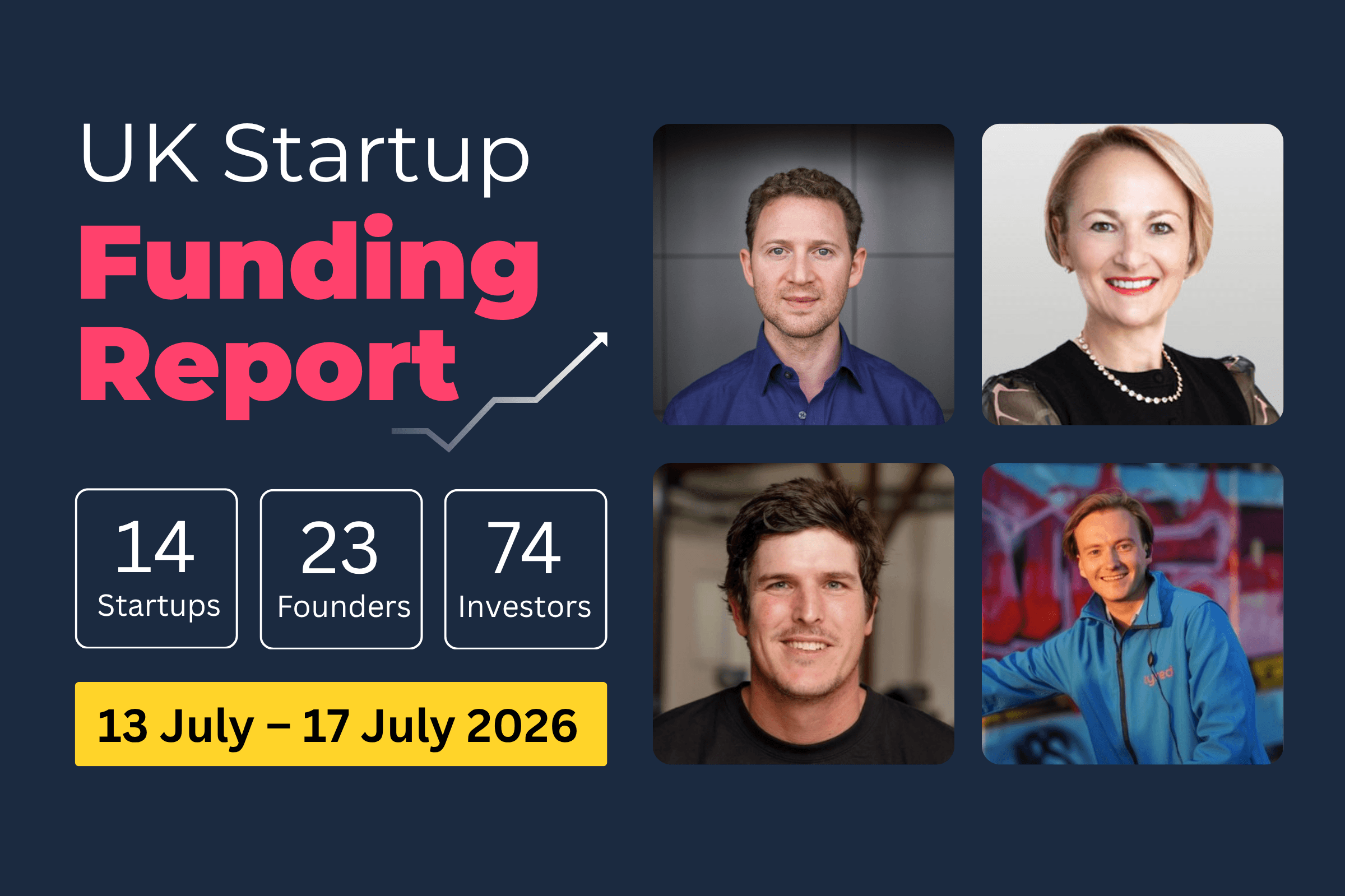
It's Friday, 17 July, and this is your UK Startup Funding Report.
UK startups raised £209.4M across the week of 13–17 Jul 2026, with deals concentrated in AI, fintech and supply chain businesses. Several rounds combined strategic corporate backers with specialist VC funds to push product development and international expansion.
AI infrastructure and applications
Startups building both foundation-level infrastructure and developer-facing AI products dominated funding this week, reflecting investor demand for sovereign control layers alongside tools that accelerate delivery. Enterprises are seeking platforms they can trust for mission-critical use while also adopting applications that boost engineering productivity and customer service.
Valarian raised £37.41 million in a Series A led by NEA to develop a sovereign infrastructure layer for mission-critical AI, supporting enterprise and defence deployments from its London base. Meticulous secured £11 million in a round led by Chemistry to scale its autonomous software-testing platform that generates and maintains large-scale test suites for engineering teams. Cue closed £3.71 million in seed funding led by Knife Capital to accelerate its AI-powered customer service platform and advance voice, security and enterprise integrations as it moves from pilots into production.
Taken together, the rounds underline appetite for both heavy infrastructure plays and nimble application builders. Lead investors range from global firms to specialist VCs, signalling cross-border and sector-focused interest. How each firm balances product development with international expansion remains to be seen, but the funding should speed commercialisation.
This week's AI & Infrastructure deals:
Valarian raised £37.4m in a Series A to build its sovereign infrastructure layer for mission‑critical AI and enterprise workloads. Led by NEA with Lightbank and others, the funding will speed delivery of workload-level governance and support both enterprise and defence deployments from its London base.
Meticulous raised £11m to develop its autonomous software‑testing platform that generates and maintains large-scale test suites for engineering teams. Led by Chemistry with Menlo Ventures and angel backers, the round will fund product scaling to help companies ship AI‑driven updates with fewer regressions.
Cue closed a £3.7m seed round led by Knife Capital and FAM Investments to accelerate its AI‑powered customer service platform and expand internationally. The funding will advance voice, security and enterprise integrations as the company moves from pilots to broader production deployments.
Payments and tokenised rails
Investment concentrated on payments infrastructure and tokenised rails this week, as backers continue to prioritise products that could reshape corporate treasury and project payments. Regulated digital-asset rails and payment-control tools promise faster settlement and clearer cashflow, but reaching scale requires substantial banking and regulatory work.
Velocity secured £28.43 million in a round led by Dragonfly to expand its stablecoin-based treasury and settlement infrastructure for enterprises and financial institutions. The company plans to use the funds to scale banking and payments connections, advance regulatory work and integrate custody services as it pushes for broader corporate adoption.
Investors remain committed to tokenised rails for the long term but are pressing for pragmatic progress on banking links and oversight. The mix of crypto-native funds and traditional VCs backing these rounds reflects a blended approach to risk; the coming months will show how well firms convert pilots into regulated, enterprise-grade services.
This week's Fintech & Payments deals:
Velocity secured £28.4m to expand its stablecoin-based treasury and settlement infrastructure for enterprises and financial institutions. Led by Dragonfly and FirstMark, the capital will be used to scale banking and payments connections, regulatory work and custody integrations as the company pushes for broader corporate adoption.
Healthtech: from clinical to consumer
Funding this week spanned clinical-stage biotech, AI diagnostics and consumer health brands, illustrating the breadth of investor interest across the health stack. Backers are allocating capital both to long-horizon drug development and to faster-moving software and consumer plays that can scale quickly
Draig Therapeutics closed £48.64 million in a Series B led by Deep Track Capital to accelerate clinical development of AMPA and GABAA receptor modulators, including its lead candidate DT-101 for major depressive disorder and ongoing Phase 2 studies. BeCertain raised £1.7 million in a pre-seed round led by Sure Valley Ventures to build an AI assistant for interpreting intraoral X-rays, offering calibrated confidence scores to support clinicians. Reformed secured £17 million in a Series A led by Iris Ventures to scale its fortified coffee and matcha subscription business and fund a planned US launch.
These rounds demonstrate that funding is available across risk profiles, from capital-intensive clinical programmes to consumer and diagnostic software. Lead investors include life-sciences specialists and consumer-focused VCs, signalling varied sector expertise. Regulatory timelines and sales traction will be key determinants of follow-on funding.
This week's Healthtech & Biotech deals:
Draig Therapeutics closed a £48.6m series B to accelerate clinical development of its AMPA and GABAA receptor modulators, including lead candidate DT‑101 for major depressive disorder. The round, led by Deep Track Capital with participation from Janus Henderson and other institutional investors, will fund ongoing Phase 2 studies and scale the company’s clinical programme.
BeCertain raised £1.7m in a pre‑seed round led by Sure Valley Ventures to develop an AI assistant for interpreting intraoral X‑rays. The software provides calibrated confidence scores to support clinicians and aims to improve diagnostic consistency across dental practice workflows.
Reformed raised £17m in a Series A led by Iris Ventures to accelerate its direct‑to‑consumer subscription business and fund a planned US launch. The brand sells fortified coffee and matcha blends and will use the capital to scale marketing, fulfilment and subscription operations after reporting strong sales traction.
Energy and deep tech
Investors this week backed hardware and software aimed at the energy transition and mission-critical systems, including grid modelling, industry-specific foundation models and sovereign sensing. Operators increasingly demand bankable models, resilient hardware and domain-specific AI to manage complex energy and defence systems, which tolerates longer development cycles in exchange for high-impact outcomes.
Gridcog raised £7 million in a Series A led by ABB to accelerate its multi-asset simulation tools and deepen integrations with developers, utilities and industrial partners that rely on bankable modelling for renewables and storage. Applied Computing secured £15 million in a growth round led by KBR, with Databricks Ventures joining, to advance its Orbital foundation model into energy operations and open a new Houston office. Silicon Microgravity raised £6 million to scale UK manufacturing and commercial deployment of rugged MEMS sensors for defence, space and dual-use markets.
The pattern is regional and industrial: corporate strategic investors are active alongside VCs when capital ties closely to deployment and supply chains. The involvement of engineering and corporate leads suggests a focus on commercial integration rather than pure research; the pace at which these technologies move from pilots to mission-critical production remains to be seen.
This week's Energy & Deeptech deals:
Gridcog raised £7m in a Series A led by ABB to accelerate its multi‑asset simulation tools for energy projects. The capital will help the company expand across Europe and deepen integrations with developers, utilities and industrial partners that rely on bankable modelling for renewables and storage.
Applied Computing raised £15m in a growth round led by KBR with Databricks Ventures joining, to push its Orbital foundation model into energy operations. The funding will support a new Houston office and further industry-specific model development for safety‑critical energy use cases.
Silicon Microgravity raised £6m to scale UK manufacturing and commercial deployment of its rugged MEMS sensors for defence, space and dual‑use markets. The funding will grow engineering and production capacity to meet interest in sovereign sensing and navigation components.
Construction, supply-chain and mobility
Startups addressing friction in the built environment attracted capital this week, from procurement and payments to supplier security and vehicle uptime. The construction and mobility sectors are pressing for digitisation that delivers price visibility, payment controls and maintenance predictability, and investors are responding to opportunities for recurring revenue and regulatory-driven adoption.
Prolo raised £4.2 million to commercialise an AI-driven procurement service for small and medium construction contractors and to fund customer acquisition and product development. Risk Ledger secured £23.9 million in a Series B led by Axiom Equity to expand its shared supplier security network and roll out new AI capabilities for its Active Supply Chain Security platform. Saible raised £2.9 million from angel investors to expand a payment-control platform for construction projects, including regulatory engagement and live pilots, while Tyred took £2.5 million to develop an AI-powered bike ownership platform that bundles predictive maintenance, insurance and finance for riders and fleets.
Taken together, these deals point to demand for cashflow and security controls across supply-chain tiers and for uptime solutions in mobility. Investors are backing a mix of early-stage pilots and scaling platforms, often with an eye to US expansion or regulatory validation. The critical metric to watch will be which models win repeat customers in a sector defined by long procurement cycles.
This week's Construction, Supply‑Chain & Mobility deals:
Prolo raised £4.2m to commercialise an AI‑driven procurement service for small and medium construction contractors. The round will fund customer acquisition and product development to reduce procurement friction, provide price visibility and offer flexible credit to smaller builders.
Risk Ledger raised £23.9m in a Series B led by Axiom Equity to expand its shared supplier security network and roll out new AI capabilities. The funding will support product development and US expansion as the company scales its Active Supply Chain Security platform, which now connects thousands of organisations.
Saible raised £2.9m from angel investors to expand its payment‑control platform for construction projects, including regulatory engagement and live pilots. Its Digital Parallel Payment Account aims to ensure funds reach approved firms across every tier simultaneously, reducing late payments and downstream insolvency risk.
Tyred raised £2.5m to build an AI‑powered bike ownership platform that bundles predictive maintenance, insurance and finance for riders and fleets. The seed funding will support sensor and model development aimed at reducing downtime and improving fleet reliability.
🎧 That's this week's Startupmag Weekly Briefing.
See you next Friday for another look at the UK startup scene.