UK Startup Funding Report: £851.7m raised across AI, Fintech and Biotech (18–22 May 2026).

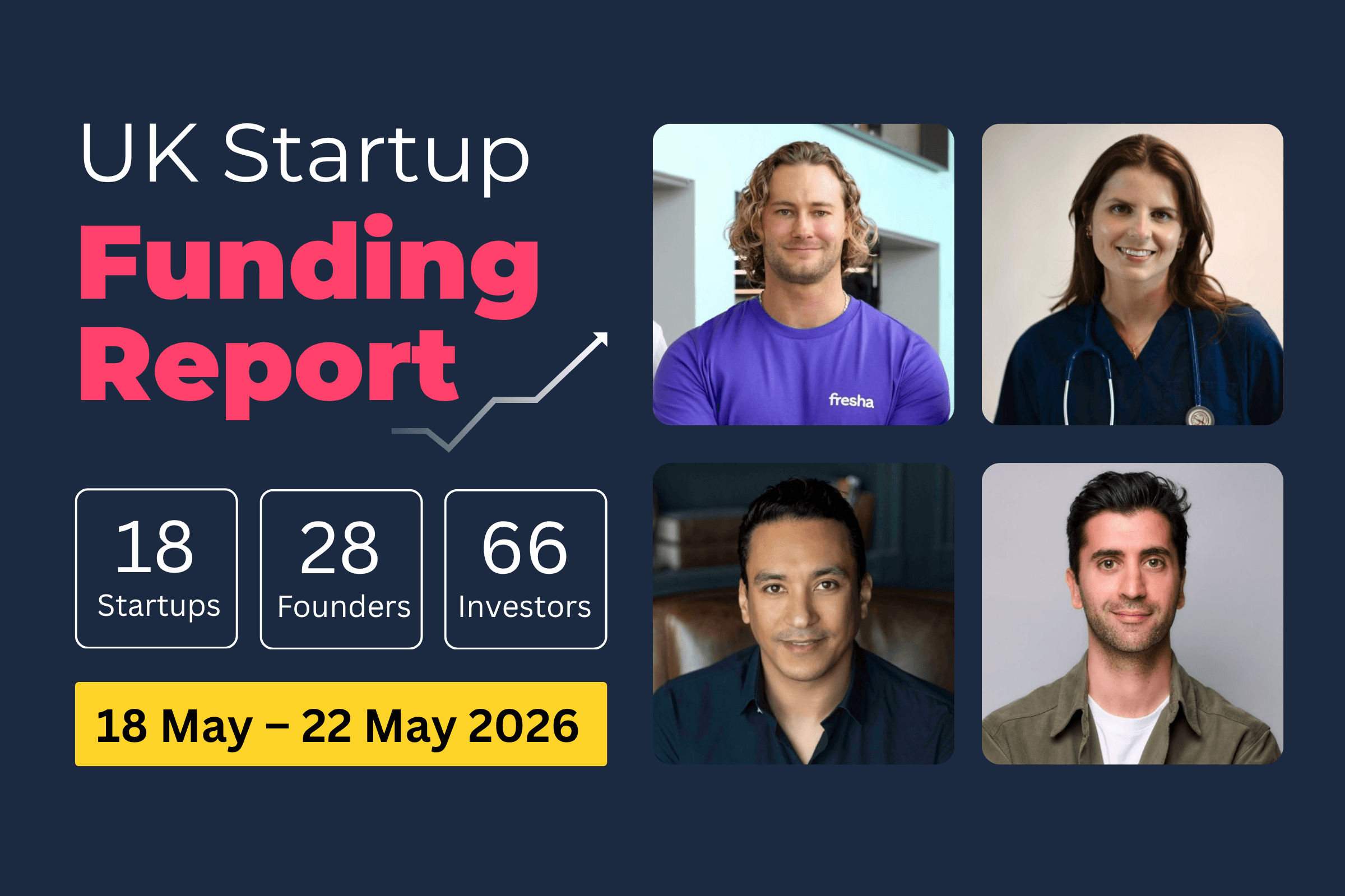
It's Friday, 22 May, and this is your UK Startup Funding Report.
A busy week of UK funding saw several large growth rounds and a raft of AI, fintech and biotech deals. In total £851.7M of capital was announced across the reporting period.
Enterprise AI focuses on productivity
This week’s funding activity underlines a pragmatic turn in enterprise AI: founders are applying machine learning and autonomous agents to established business problems such as workforce training, inspection and routine office work. Investors are favouring companies that automate repetitive tasks and deliver measurable time savings, an attribute that makes it easier to convert enterprise interest into recurring revenue.
Recent rounds reflect that emphasis. Fresha raised £59.59 million in a growth round led by KKR to accelerate international expansion and to deepen an AI-led roadmap that automates scheduling, payments and marketplace features. Multiverse secured £52 million from Schroders Capital to scale its skills‑mapping and AI training platform across Europe and build workforce upskilling products. Scope AI took £14.91 million in a round led by Index Ventures to speed adoption of an inspection platform that captures live audio and video and automates reporting for field inspectors. And Rightbrain closed a £3 million seed round led by PXN Ventures to embed AI agents into CRMs and common workflows for SMEs and mid‑market firms.
Taken together, the deals point to regional appetite for enterprise‑facing AI that reduces friction in existing processes. Investors appear to prefer pragmatic product roadmaps and clear customer use cases — from automating bookings and training staff to inspecting assets and embedding agents into business tools.
This week's AI deals:
Fresha raised £59,590,000 in a growth round led by funds managed by KKR to push international expansion and deepen its AI-led product roadmap. The booking and business-management platform for beauty and wellness says the funding supports continued profitable growth and further automation across scheduling, payments and marketplace features. The deal also moves Fresha closer to a high valuation as it scales globally.
Multiverse secured £52,000,000 to expand its skills-mapping and AI training platform across Europe and develop workforce upskilling products. Led by Schroders Capital, the round will fund product development and international hires as the company supports employers translating AI investment into practical skills. The firm says the funding follows accelerating revenue and its first cash-positive quarter.
Scope AI raised £14,910,000 in a growth round led by Index Ventures to speed adoption of its AI inspection platform for the testing, inspection and certification sector. The platform captures live audio and video to automate reporting and reduce administrative time for field inspectors. The funds will support expansion of the London team and deployments with large inspection firms.
Rightbrain raised £3,000,000 in a seed round led by PXN Ventures to embed AI agents into CRMs and common workflows for SMEs and mid-market firms. The company offers agents-as-a-service that integrate major models with existing tools to speed practical adoption without heavy engineering lift. Funding will support partner growth and hires to scale the platform across professional services.
Payments and payroll scale internationally
Investors this week doubled down on payments and payroll infrastructure that can scale across borders. The financings span stablecoin settlement, AI‑native payment stacks and employer services aimed at simplifying global hiring and pay — all responses to demand for faster, cheaper cross‑border value movement and richer payments data for merchants.
Notable rounds illustrate the split between very large infrastructure plays and specialised platform builders. LemFi closed a £585 million growth round led by Tether to accelerate USD₮ settlement for remittances and shorten corridors to Africa and Asia. Primer raised £75 million in a Series C led by Sofina to develop an AI‑native payments infrastructure that centralises payment data and automates decisioning for merchants. RemotePass took £13 million in a Series B led by EBRD Venture Capital to scale its global employment, payroll and spend platform, extending employer‑of‑record services and embedded financial products.
Overall, investors are backing companies that can either rewrite settlement rails at scale or embed payments into HR and spend workflows, reflecting a pragmatic search for both efficiency and new revenue layers in cross‑border commerce.
This week's Fintech & Payments deals:
LemFi closed a £585,000,000 growth round to accelerate stablecoin (USD₮) settlement for remittances, aiming to cut times and costs on key corridors to Africa and Asia. The round, led by Tether, will fund wider integration of stablecoin rails and international expansion of its payments platform. The company says the capital will help scale near-instant settlement for millions of cross-border users.
Primer has raised £75,000,000 in a Series C led by Sofina to build AI-native payments infrastructure that centralises payment data and automates decisioning for merchants. The capital will be used to expand product lines like reconciliation and global accounts, and to grow teams as Primer targets international scale. Investors backed the company’s aim to combine orchestration with machine-led optimisation of payments.
RemotePass closed a £13,000,000 Series B led by EBRD Venture Capital to grow its global employment, payroll and spend platform. The company will use the money to scale product features such as employer-of-record services and embedded financial products as it expands into Europe and the US. Investors pointed to RemotePass’s profitability and efficient capital use as reasons to back further expansion.
Healthtech backs sustainable biotech and clinical AI
Funding this week highlights investor interest across two complementary areas: lab‑to‑scale biotech targeting sustainability, and platform healthtech that eases clinical workloads. The rounds cover enzyme engineering for industrial use, engineered biomaterials and hospital‑deployed AI for infection prediction and ear care.
Imperagen raised £5 million to scale enzyme engineering that combines quantum physics, AI and automation and to expand wet‑lab capacity and commercial efforts. QuberTech secured £3.4 million in seed funding—combining grants and equity—to accelerate R&D on engineered dandelions that produce sustainable natural rubber and other bioproducts. TympaHealth received a £2 million Innovate UK loan to advance Tympa Assist, an AI‑guided ear and hearing care platform with otoscopy support and referral integrations. NEX Health Intelligence raised £870,000 in a pre‑seed round led by Brighteye Ventures to expand hospital deployments of an infection‑prediction platform that uses AI and bed‑record modelling.
These investments underline appetite for technologies that shorten development timelines or reduce pressure on specialist clinical services, whether by speeding commercial validation in the lab or by delivering practical tools at the point of care.
This week's Healthtech & Biotech deals:
Imperagen raised £5,000,000 to scale its enzyme engineering work combining quantum physics, AI and automation, and appointed Guy Levy-Yurista as CEO. The funding will expand wet lab capacity and commercial efforts across pharmaceuticals, personal care and industrial biotech. Investors expect the platform to speed discovery of high-performing enzyme variants for greener manufacturing routes.
QuberTech raised £3,400,000 in seed funding to accelerate R&D on engineered dandelions that produce sustainable natural rubber and other bioproducts. The funds combine grants and equity from UKI2S and Sustainable Ventures and will support pilot-scale validation as the company moves toward commercial deployment. The technology aims to provide a local, climate-resilient alternative to tropical rubber supply chains.
TympaHealth secured a £2,000,000 Innovate UK loan to accelerate Tympa Assist, an AI-guided ear and hearing care platform for community settings. The loan will fund clinical features, Otoscopy Assist and referral integrations to ease pressure on specialist services. The company plans to use the funding to align the product with NHS pathways and expand roll-out.
NEX Health Intelligence raised £870,000 in a round led by Brighteye Ventures.
Hardware and cloud‑efficiency tools attract capital
Investors put capital into hardware‑led manufacturing plays and software that reduces cloud and AI emissions, signalling a dual focus on onshoring production and squeezing inefficiency from large cloud deployments. The activity suggests a balance between building physical capacity and providing tooling that delivers immediate cost and carbon savings.
CircuitHub raised £21 million in a round led by Plural to expand its automated electronics manufacturing platform and roll out more of its factory Grid across Europe and the US. Greenpixie secured £4.7 million in a round led by VERBUND X Ventures to scale sustainability intelligence tools that reclaim idle cloud resources and optimise workloads to cut cloud and AI emissions. Both companies plan to use the funds to accelerate product deployment and enterprise rollouts.
The deals point to continued investor interest in tightening hardware supply chains while also funding software that makes cloud infrastructure more efficient. Expect further capital to flow to firms that can demonstrate near‑term emissions and cost reductions for enterprise customers.
This week's Deep Tech, Greentech & Infrastructure deals:
CircuitHub raised £21,000,000 to expand its automated electronics manufacturing platform and roll out more of its factory Grid across Europe and the US. The funding, led by Plural, will accelerate deployment of automated prototyping and small-batch production to shorten hardware development cycles. The company aims to help engineers move from design to production faster and bolster onshore manufacturing capacity.
Greenpixie raised £4,700,000 to expand sustainability intelligence tools that cut cloud and AI emissions by reclaiming idle resources and optimising workloads. Led by VERBUND X Ventures, the capital will fund product development and enterprise rollouts that target cost and carbon reductions for large cloud users. The company positions its tooling as FinOps and GreenOps for AI infrastructure.
Specialist infrastructure tooling retains investor interest
Smaller rounds this week show steady appetite for cybersecurity, analytics, developer productivity and connectivity enablers. These companies typically focus on infrastructure visibility, measurement and wholesale connectivity that enterprises and operators need to reduce operational risk and speed deployment.
Infrawatch raised £2.2 million in a pre‑seed round co‑led by Outward VC and Triple Point Ventures to build an infrastructure intelligence layer that maps servers, domains and other attacker infrastructure and gives earlier signals to security teams. eSIM Go secured strategic growth funding led by TNS Global to accelerate geographic expansion and deepen its UK MVNO and travel eSIM offerings; the company did not disclose the amount. Both moves are pitched at solving hard operational problems for security teams and travel connectivity providers.
These investments underline a preference for infrastructure plays that deliver measurable operational improvements. It will be worth watching whether these smaller rounds translate into larger strategic partnerships or acquisitions over time.
This week's Other — Cyber, Data, Developer Tools & Telecom deals:
Infrawatch raised £2,200,000 in a pre-seed round co-led by Outward VC and Triple Point Ventures to build an infrastructure intelligence layer for security teams. The platform maps servers, domains and other attacker infrastructure to give earlier signals and reduce time to mitigation. The funds will accelerate product development and US expansion for enterprise deployments.
eSIM Go secured strategic growth funding led by TNS Global to accelerate geographic expansion and deepen its UK MVNO and travel eSIM offerings. The investor arrangement is described as strategic and will support product development and regional roll-outs, though the company did not disclose the amount raised. The deal aims to scale the firm’s connectivity platform and partner routes into Eurasia and other markets.
🎧 That's this week's Startupmag Weekly Briefing.
See you next Friday for another look at the UK startup scene.