UK Startup Funding Report: £560.1m raised across AI, Biotech and Healthtech (1–5 Jun 2026).

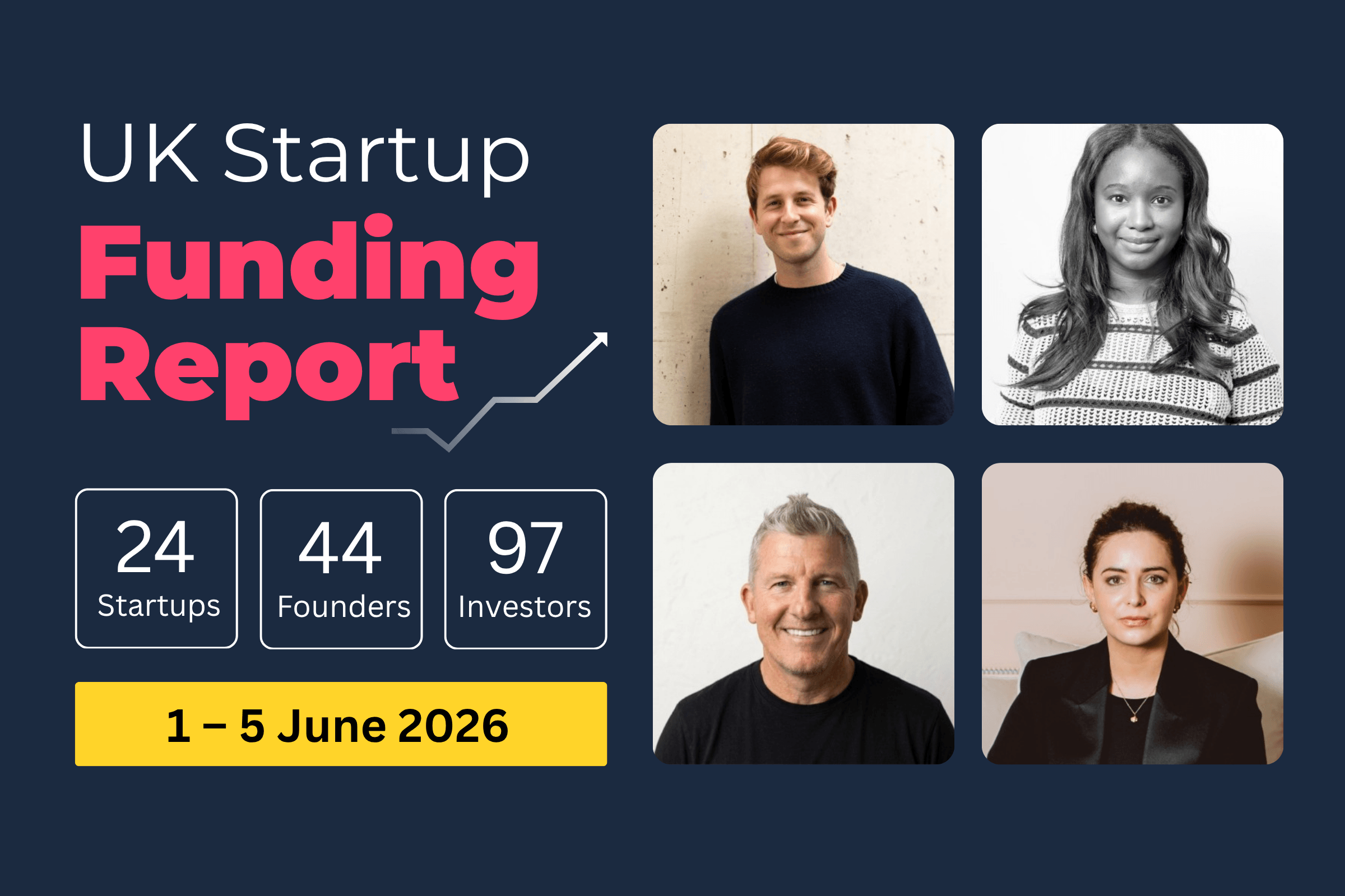
It's Friday, 5 June, and this is your UK Startup Funding Report.
From 1–5 Jun 2026 UK startups raised a total of £560.1M, led by big checks into AI, biotech and healthtech. The week saw large growth rounds and a steady flow of early-stage deals across deep tech and clinical AI.
AI and automation move from insight to execution
Startups are building agentic layers, voice and vision stacks and automation systems that act on live operational data rather than merely analysing it. This week’s activity underlines an investor shift towards AI‑first infrastructure that can execute — from revenue agents to physical‑world vision and voice solutions — because execution technology has the potential to reshape day‑to‑day operations and open new enterprise markets.
Several financings illustrate the trend. Airspeed raised £15m to scale its agent‑native go‑to‑market platform and to expand internationally, particularly into the US, though the lead investor was not disclosed. Manako Labs secured £745,000 in a pre‑seed from TaoWeave, which also took North American commercialisation rights, to convert camera feeds into operational intelligence for factories, warehouses and retail sites. AethexAI closed £2.2m to scale voice infrastructure for enterprises across Africa and the Middle East, focusing on reliability in low‑bitrate telecom environments, while Handshaik raised £1.7m to build an AI‑native deal origination platform that automates profiling, contact enrichment and pipeline workflows for corporate finance teams.
The pattern is clear: investors prefer infrastructure that can act as well as observe. London remains a hotbed for these plays, but product roadmaps point to rapid international distribution and growing cross‑border competition for enterprise customers.
This week's AI & Automation deals:
Airspeed raised £15m to scale its agent‑native go‑to‑market platform and expand internationally, particularly into the US. The capital will fund hiring and product development as the company pushes autonomous agents into revenue operations.
Manako Labs raised £745k in a pre‑seed round from TaoWeave, which also secured North American commercialisation rights. The startup converts existing camera feeds into operational intelligence for factories, warehouses and retail sites.
AethexAI raised £2.2m in a seed round to scale its voice infrastructure for enterprises across Africa and the Middle East, focusing on reliability in low‑bitrate telecom environments. The funds will expand engineering and enterprise deployments across target markets.
Handshaik closed a £1.7m pre‑seed to build an AI‑native deal origination platform that automates company profiling, contact enrichment and pipeline workflows. The funds will support product development and data acquisition for corporate finance teams and advisers.
Healthtech funding targets clinically validated platforms
Capital is flowing into clinical platforms, immune‑ and single‑cell datasets, AI‑driven discovery and regulated AI care. This week’s activity shows investors favouring companies with clinical or regulatory traction or those that can productise large biomedical datasets for drug developers and health systems — funding that follows demonstrable pathways to market rather than pure hypothesis.
Notable rounds reflect that emphasis. IMU Bioscience closed £39.4m in a series A to scale its clinical immune‑profiling platform and advance programmes in transplantation and cancer immunotherapy, expanding its dataset and platform infrastructure. Inherent raised £37.2m to develop Faraday, a platform of self‑improving AI agents intended to accelerate long‑horizon scientific discovery, supporting compute‑heavy research and product work. Flok Health secured an oversubscribed £9.5m series A to scale its AI‑operated physiotherapy clinic and expand NHS roll‑outs for back pain and other MSK pathways. Gnosis Health raised £1.1m to develop MAXine, an AI‑powered digital assistant for people with Parkinson’s disease, and to run NHS pilots supported in part by an Innovate UK investor partnership grant.
Investors are drawn to businesses that combine rich data, clinical validation and clear routes to regulated customers. The UK market is showing strength across early‑stage pilots and larger rounds that prime platform scale‑up for partnerships with drugmakers and the NHS.
This week's Healthtech & Biotech deals:
IMU Bioscience closed a £39.4m series A to scale its clinical immune‑profiling platform and advance programmes in transplantation and cancer immunotherapy. The cash will expand its dataset and platform infrastructure to support translational projects and partnerships with drug developers and research consortia.
Inherent raised £37.2m to develop Faraday, a platform of self‑improving AI agents aimed at speeding long‑horizon scientific discovery. The round backs compute‑heavy research and product development as the company pursues ambitious AI‑for‑science goals.
Flok Health raised an oversubscribed £9.5m series A to scale its AI‑operated physiotherapy clinic and expand NHS rollouts for back pain and other MSK pathways. The funds will support wider deployment, new clinical pathways and geographic expansion.
Gnosis Health raised £1.1m to develop MAXine, an AI‑powered digital assistant for people with Parkinson’s disease, and to run NHS pilots. The round combines private investment with an Innovate UK investor partnership grant to prepare the product for commercial launch.
Investors favour deployable decarbonisation and circular materials
Funders are targeting industrial decarbonisation, circular materials and novel coatings, backing both software and hard materials work that can be deployed to cut carbon and strengthen domestic supply chains. The emphasis this week was on practical technologies with measurable emissions reductions and operational resilience.
Key financings illustrate the mix. Gigaton closed a £20m series A to scale autonomous control software for energy‑intensive industries such as cement and steel, aiming to cut costs and carbon at large plants. DEScycle raised £5.5m to build a Teesside demonstration plant and validate a modular metals recovery process for electronic waste through industrial trials. Circular11 secured £2.4m to scale production that converts low‑quality plastic waste into composite lumber for fencing and infrastructure, diverting material from incineration to longer‑life uses. Apoha emerged from stealth with £26.81m to advance its liquid‑state intelligence materials, accelerating prototypes towards manufacturable products and early commercial partnerships.
The pattern is consistent: investors will back both control‑software and materials projects where there is a clear route to measurable carbon savings and enhanced domestic industrial capacity. Regional activity spans Teesside, Dorset and London.
This week's Greentech & Advanced Materials deals:
Gigaton closed a £20m series A to scale its autonomous control software for energy‑intensive industries such as cement and steel. The company will expand deployments that aim to cut operational costs and carbon across large industrial plants.
DEScycle closed £5.5m to build a Teesside demonstration plant and validate its modular metals recovery process for electronic waste. The capital will extend operations, generate process data and support trials with industrial partners.
Circular11 raised £2.4m to scale manufacturing that converts low‑quality plastic waste into composite lumber for fencing and infrastructure. The investment will support production scaling and divert plastic from incineration into longer‑life materials.
Apoha came out of stealth with a £26.8m growth round to develop its 'liquid-state intelligence' materials work. The funding will accelerate prototype development and the path from lab demonstrations towards manufacturable products and early commercial partnerships.
B2B platforms win growth capital for measurable ROI
B2B platforms and vertical marketplaces are digitising workflows across legal, retail, hospitality, mobility and identity security. Investors favour software that converts operational processes into instrumented, automatable systems with clear returns, and this week’s funding highlights firms replacing manual work with products that can be measured and scaled.
Several rounds underline the appeal. Wordsmith raised £55m in a series B to develop its legal operations platform, expand legal engineering features including AI workers, and scale customer roll‑outs. Tilt secured £19.36m to accelerate product development and European expansion for its live‑commerce resale platform, supporting AI feature growth and market defence. MokN closed an £11.17m growth round led by GV to scale its Phish‑Back identity protection product and expand into the US while funding R&D and hiring. Aveni raised £12m to build a Unified Assurance Platform to monitor and approve agentic AI in financial services, targeting assurance of conduct and consumer outcomes where AI agents interact with customers.
The common thread is measurable ROI and defensible productisation, which attract growth capital. Expect continued investor interest in platforms that can prove immediate cost savings or regulatory compliance benefits.
This week's Enterprise & Marketplaces deals:
Wordsmith raised £55m in a series B to develop its legal operations platform and expand its legal engineering features, including AI workers and a reporting subsystem. The funding will help the company scale product development and customer roll‑outs for in‑house legal teams.
Tilt raised £19.4m in growth capital to accelerate product development and European expansion for its live‑commerce resale platform. The funds will be used to scale AI features, grow the team and defend local market share against larger US entrants.
MokN closed an £11.2m growth round led by GV to scale its Phish‑Back identity protection product and expand into the US. The funding will support R&D, hiring and wider productisation of its active identity recovery approach.
Aveni raised £12m to build its Unified Assurance Platform and launch products that monitor and approve agentic AI in financial services. The round will fund product launches aimed at assuring conduct and consumer outcomes where AI agents interact with customers.
🎧 That's this week's Startupmag Weekly Briefing.
See you next Friday for another look at the UK startup scene.