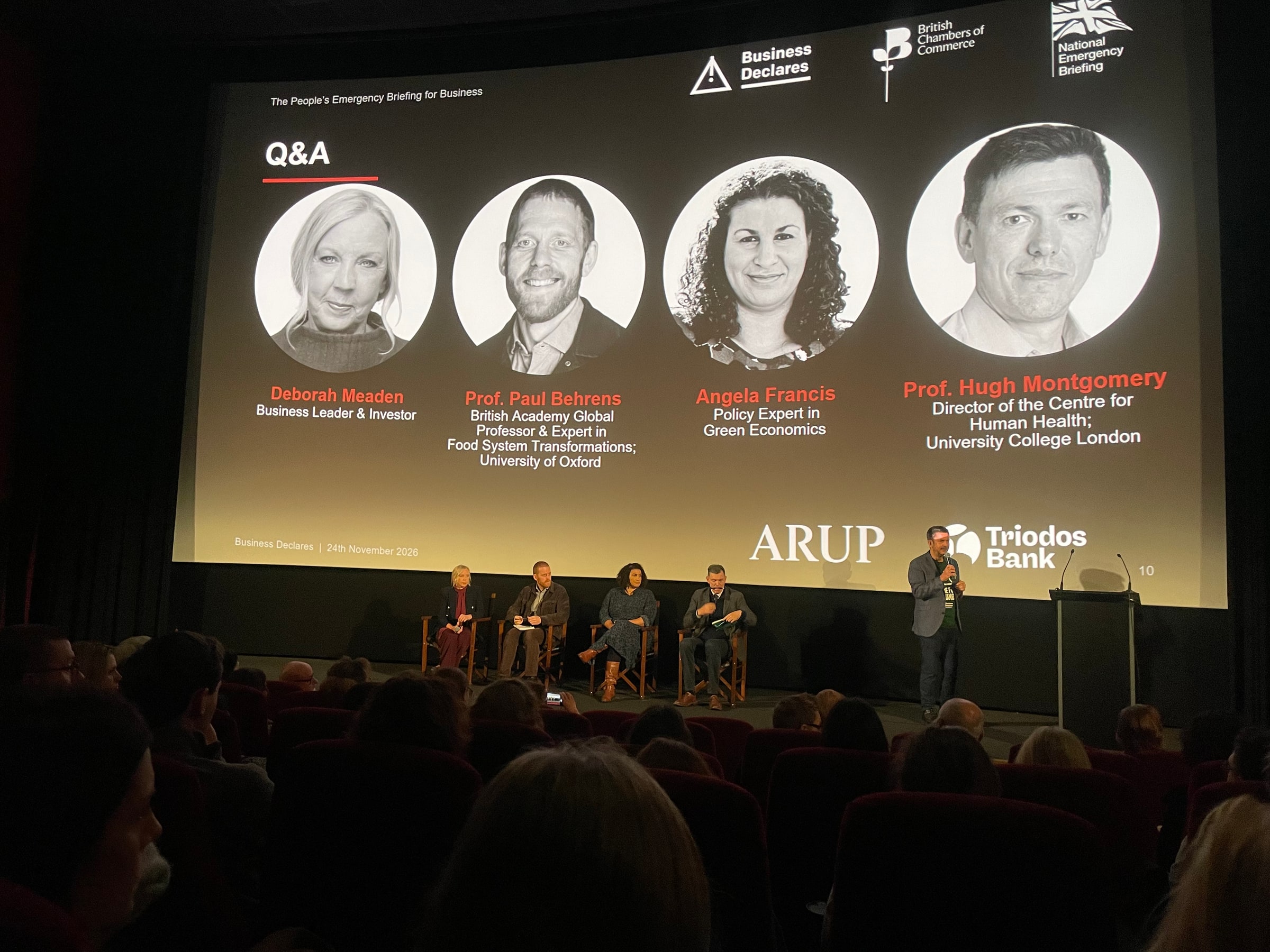
This morning, I joined business leaders at Picturehouse Central in London for the Business Emergency Briefing, organised by Business Declares.
The event brought together scientists, economists, entrepreneurs and business professionals for a screening of The People's Emergency Briefing, followed by a panel discussion featuring Deborah Meaden, Angela Francis, Professor Hugh Montgomery and Professor Paul Behrens.
I went along without a particular agenda. I left thinking about what I could do.
Climate change is something I've long been aware of, but the sheer scale of the challenge can make it difficult to understand how much of a difference any one of us can make.
One of the most powerful moments of the morning came from Professor Hugh Montgomery, who spoke about his son and his desire to one day be able to tell him that he had tried, that he had done everything he could.
It was a simple but powerful message, and one that extends well beyond climate change.
Deborah Meaden returned to this sentiment during the panel discussion, emphasising the importance of bringing that same emotional connection into the boardroom. How do we communicate the urgency of the situation in a way that resonates with the people around us?
Alongside Deborah, Angela Francis highlighted the commercial importance of acting now. The decisions businesses make today can help determine their resilience tomorrow, and delaying necessary changes could ultimately prove more expensive.
Together, their perspectives brought home an important message: addressing climate change and building successful businesses are not mutually exclusive.
The growth of industries around renewable energy, electric vehicles and battery technology demonstrates how environmental challenges can also create substantial economic opportunities.
Across the UK, entrepreneurs are developing new technologies, rethinking established industries and building businesses around these very challenges.
And investors are putting their money behind them.
At Startupmag, we spend every day following the people building and financing the next generation of UK businesses. Perhaps one of the most useful contributions we can make is to give greater visibility to those working on solutions.
So, who are the UK founders raising capital to tackle our environmental challenges? What are they building? And who are the investors helping them turn their ideas into reality?
We've turned to Startupmag's funding data to find out.
UK sustainability startup funding in 2026
A climate business is not always labelled Climate Tech. In Startupmag’s database, relevant companies sit in Greentech and Energy, but also in Agtech, Biotech, Advanced Materials, Construction, Proptech, Mobility, SaaS and even Healthtech. We reviewed what they actually build, rather than treating a sector label as proof of environmental relevance.
Our review of announcements recorded from 1 January to 24 November 2026 identified 95 UK businesses working directly on environmental challenges. Across 88 announcements with a usable GBP amount, the disclosed funding comes to at least £805.1m. This is a reviewed Startupmag cohort, not a census of all UK climate investment.
- UK businesses in the reviewed cohort
- 95
- Disclosed funding, GBP lower bound
- £805.1m
- Named investors, lenders and investment vehicles
- 242
- Announcements included in GBP total
- 88
The backer count identifies 242 named investors, lenders and investment vehicles in the selected announcements. A fund or angel network counts as one named backer, not as all the people behind it. Unnamed participants are excluded, as are grant-only providers from this investor-and-lender count. Three named grant providers bring the wider funding-participant count to 245.
The funding total includes £59.2m of identified loans and £26.7m of separately identified grants. Another £21.6m comes from combined packages whose public/private split is not fully disclosed. The remaining £697.6m is investment funding, including £79.3m explicitly identified as equity in our component audit. It would be misleading to call the full £805.1m venture capital.
Funding by primary environmental challenge
- Clean power, storage and industrial energy
- £434.8m
- Circular materials, waste and packaging
- £155.7m
- Buildings and construction
- £39.2m
- Food, farming and alternative feedstocks
- £117.6m
- Nature, water and climate resilience
- £21.9m
- Transport and charging
- £33.3m
- Healthcare emissions
- £2.5m
These are mutually exclusive editorial groups: each announcement appears in one group only. They describe the problem a business addresses, while preserving its existing Startupmag taxonomy. Figures are rounded, so displayed subtotals may not add exactly to the displayed headline.
Four announcements do not disclose an exact current amount that we could corroborate. Two more give a cumulative figure or a fundraising target rather than a current closed-round amount. Superlight discloses a $21m round, which is retained as disclosed funding but excluded from the GBP sum because its conversion needs corroboration. None of these seven announcements has been assigned a made-up value.
Several large-looking records required particular care. Kraken’s standalone investment announcement was dated December 2025, so it is outside this period. An imported Sparxell release described an April 2024 raise. Neither is included. Enviromena’s £825m solar financing envelope, including a £300m uncommitted accordion, is infrastructure financing and sits outside this startup cohort. A fund raising money for its own future investments is also not a startup funding transaction.
Values were checked against the underlying announcements. Clean Food Group’s £4.5m investment and £700,000 grant, for example, form one £5.2m package. Targets, earlier rounds and the same transaction repeated in weekly summaries are not added again.
Meet the UK startups building solutions
Behind that total are people trying to make difficult changes work in ordinary commercial settings: a construction site, a wastewater plant, a food factory or an electricity network. The businesses below illustrate different routes, rather than a ranking of environmental impact. Money raised does not establish how much carbon a product will avoid, and early-stage technologies still have to prove their performance at scale.
Making buildings with less waste
Agreka Build
Turning straw into insulation
Architectural and regenerative designer Antoinette Oni, social entrepreneur My Linh Nguyen and civil engineer Han Ming Lai are among Agreka Build’s co-founders. Their work turns waste wheat straw into insulation for buildings, connecting an agricultural by-product with a construction need. The Cheshire business secured £200,000 from Lifted Ventures Angels, Ecosia and Minerva Business Angels. The investment supports the next stage of development for a material that starts with a resource farmers already produce.
Qflow
Giving construction teams a clearer view of materials
Civil engineer Brittany Harris and environmental scientist Jade Cohen co-founded Qflow to tackle the gap between what a project specifies and what arrives on site. Its software captures delivery and waste data so teams can identify material issues and reduce avoidable rework. US-based Autodesk’s £2m strategic investment links that construction-site information with design software.
Mykor
Growing an alternative building material
Mykor’s founders Olivia Page and Valentina Dipietro are developing prefabricated construction products grown with mycelium using industrial and agricultural waste. The aim is to change the material itself, rather than only improving how conventional products are managed. Its £4m funding package brings together Clean Growth Fund, The FSE Group through the South West Investment Fund, Green Angel Ventures and Innovate UK support. It combines investment with public innovation support.
Using cleaner energy where it is hardest to switch
Exergy3
Turning surplus electricity into industrial heat
Edinburgh spinout Exergy3 is developing thermal storage that turns renewable electricity into heat for industrial processes. Markus Rondé leads the business; the problem is practical rather than abstract: factories need reliable heat even when wind and solar output vary. Its £10m seed round was led by France’s Axeleo Capital, with Bayern Kapital and Singapore-based Kibo Invest joining Scottish Enterprise, Zero Carbon Capital and Old College Capital.
Rivan
Building a substitute for fossil natural gas
Harvey Hodd founded Rivan to produce synthetic natural gas from renewable electricity and captured carbon dioxide. It is aimed at applications where replacing the equipment using gas is difficult. The business raised £25m in an IQ Capital-led round, with Plural, Fundomo and angels including Thomas Wolf, Matt Clifford and Markus Villig. Whether synthetic fuels deliver the intended environmental benefit depends on energy inputs and the full production process, so no carbon-saving estimate is assumed here.
Nexeon
Making the materials inside a battery
Nexeon develops silicon anode materials for lithium-ion batteries, targeting improved battery performance. Its £100m round brings together the UK’s National Wealth Fund, Korea Development Bank and Honda. Chief executive Scott Brown leads the business as it scales the materials and manufacturing needed for the battery supply chain.
Making electric transport easier to use
Enera
Helping drivers complete their charge
Nicholas Marquardt and Arnaldo Vera founded Enera to help charging operators resolve problems when drivers plug in. Its software brings together charger telemetry, support calls and backend logs so operators can diagnose faults and assist drivers. The London and Barcelona business announced a $2m pre-seed round in June, led by Lakehouse Ventures with Divergent Capital and Masia. It is piloting its platform with UK charging operators.
Keeping materials in use
Shellworks
Replacing plastic packaging at the material level
Insiya Jafferjee and Amir Afshar co-founded Shellworks, which makes Vivomer, a fermentation-derived alternative to conventional plastic packaging. The London company raised $15m in a Series A led by France’s Alter Equity, with NFDG, JamJar Investments and existing backers participating. Startupmag records the round at approximately £11.25m. Its challenge is to supply an alternative that packaging customers can use in practice, at a commercially workable scale.
Greyparrot
Showing recycling operators what passes along the belt
Mikela Druckman and Ambarish Mitra co-founded Greyparrot to use AI to identify and analyse waste moving through sorting facilities. Better information can help operators decide where materials are being lost and where to change their processes. Its announced $27m Series B, led by technology investor Omar Mir, is recorded at approximately £20.3m in Startupmag. Its next phase of growth focuses on expanding the information available to recycling operators.
Pulpex
Taking fibre bottles into manufacturing
Pulpex licenses fibre-based bottle technology as an alternative to conventional plastic and glass packaging. Its latest £24.6m financing includes £19.6m from the National Wealth Fund and £4.4m from the Scottish National Investment Bank, alongside existing investor support. The financing accompanies its Glasgow facility and the next stage of commercial deployment. Managing director Scott Winston and the team are moving from technology development into wider manufacturing deployment.
Rethinking food and industrial ingredients
Tropic
Helping crops survive disease and reduce spoilage
Gilad Gershon and the Tropic team in Norwich are developing gene-edited banana and rice varieties, including traits aimed at longer shelf life and disease resilience. The business announced a $105m Series C, recorded by Startupmag at approximately £78.6m. Forbion’s Bioeconomy Fund and Corteva Catalyst co-led it, with backers including Just Climate and IQ Capital. For Gershon and the team, the next challenge is translating crop development into reliable commercial supply.
Fermtech
Finding more value in cocoa side streams
Andy Clayton’s Fermtech uses fermentation to turn cocoa shells into Koji Cocoa, an ingredient for food manufacturers. The practical question is whether more of a crop can become a useful product instead of being discarded or underused. Its £2.5m seed round was led by Elbow Beach, with Carbon13 and Empirical Ventures. Clayton’s team is working to bring that ingredient to more food manufacturers as it scales production.
Neela Biotech
Testing a route from organic waste to aviation-fuel feedstocks
Deepanshu Singh and Friederike Nintzel co-founded Neela Biotech. Its controlled microbial process is intended to turn food, agricultural and forestry waste into feedstocks compatible with existing aviation-fuel production processes. A £2.1m pre-seed round, including £1.5m from lead investor Elbow Beach, supports a pilot-scale trial. Ascension, Cambridge Enterprise and Ventures Together also participated. Commercial cost parity remains a development ambition, not an achieved result.
Restoring nature and recovering water resources
Verna
Helping nature projects move beyond a report
Rafi Cohen and Matthew Brown co-founded Verna to help organisations plan and track nature recovery. Its software brings ecological and project information together across programmes that may involve several organisations over many years. Verna raised £3m in a round co-led by NAP and Übermorgen, with named participants including Love Ventures and Climate VC. The value of the software will depend on what users do with its information, not simply on the volume of data collected.
Metal Morph
Recovering the chemicals used to clean water
For Moletsane Mophethe, the problem has a personal starting point: growing up with uncertain access to clean water in Lesotho. Metal Morph is developing systems to recover aluminium- and iron-based chemicals from wastewater and return them to the treatment process. Its £700,000 pre-seed round was co-led by Sustainable Ventures and Green Angel Ventures, alongside Aqcelerator and Found Capital. The round supports further pilots and validation, rather than proving every claimed benefit at commercial scale.
BirdsEyeView
Understanding a changing physical risk
James Rendell’s BirdsEyeView develops catastrophe modelling and exposure tools using satellite data and machine learning, including a wildfire model. Its round was led by 24 Haymarket. The announcement describes a seven-figure investment but does not give an exact amount, so the company is included in the cohort while its funding is left out of the money total. European Space Agency support is not treated as proof that the agency invested in this particular round.
Solutions do not all sit in an obvious climate category
SageTech Medical
Recovering anaesthetic that would otherwise be wasted
Paignton-based SageTech Medical captures waste anaesthetic agents so they can be recovered and reused. It appears in Healthtech, illustrating why this review reads product descriptions rather than using only environmental sector filters. The business raised £2.5m through The FSE Group’s management of the South West Investment Fund. Chief executive Iain Menneer leads the company as it expands the use of its recovery technology.
Meet the investors backing sustainable innovation
The useful test is whether a backer financed one of these businesses during the period. An investor’s interest in sustainability, or a portfolio company from an earlier year, is not enough. The examples below are tied to named funding announcements. “Impact” describes an investment approach and can overlap with venture capital, corporate capital or public finance; it is not added as a separate investor in the count.
Venture capital and impact-focused funds
Clean Growth Fund
The UK-based fund appears in the reviewed rounds for AmpliSi, Clean Food Group, Mykor, Gigaton, Reclinker and HydRegen. Those links span batteries, food ingredients, construction and industrial processes. Six appearances here mean six selected announcements naming the fund, not six investments inferred from its stated preferences.
Elbow Beach
The UK-based investor led Fermtech’s £2.5m seed round and Neela Biotech’s £2.1m pre-seed round, including a £1.5m investment in Neela. These are two actual financing links between the reviewed food-ingredient and aviation-feedstock businesses and their backer.
Green Angel Ventures
The UK-based investor participated in the selected Mykor, Greenpixie, Sorted Technologies and Metal Morph announcements. It combines angel-backed and fund capital, so its appearances are not counted again under every overlapping label. Its Metal Morph co-investment also gives a concrete example of investors working together.
Forbion
The Netherlands-based investor co-led Tropic’s $105m Series C through its Bioeconomy Fund. This is international capital financing a UK crop-technology company. Forbion and the fund are treated as one backer for this round.
Zero Carbon Capital
Zero Carbon Capital backed Exergy3’s £10m seed round in April. That investment connects its team with Markus Rondé’s work on industrial heat storage. The cohort also names the fund in Caudal Energy, Nuclear Turbines and Reclinker financings during the research period.
Climate VC
Verna’s January announcement names Climate VC among its UK fund backers. Its participation supports the team building software to plan and monitor nature recovery. This is a financing link within the research period, rather than an inference from the fund’s climate focus.
Sustainable Ventures
Sustainable Ventures co-led Metal Morph’s £700,000 pre-seed round alongside Green Angel Ventures. Its backing supports Moletsane Mophethe’s work recovering treatment chemicals from wastewater. The cohort also records investments in QuberTech, SolarSub and Rookwood Operations during the period.
Carbon13
Carbon13 participated alongside Elbow Beach and Empirical Ventures in Fermtech’s £2.5m seed round in April. Its investment backs Andy Clayton’s team as it develops fermented ingredients that can replace some conventional cocoa in food manufacturing.
Just Climate
London-based Just Climate invested in Tropic’s $105m Series C in March. Its participation puts capital behind Gilad Gershon’s team and crop varieties designed to reduce spoilage and improve disease resistance. The round total is shared with other backers, not Just Climate’s individual contribution.
IQ Capital
IQ Capital led Rivan’s £25m round and also participated in Tropic’s Series C. These investments connect the firm with Harvey Hodd’s synthetic-fuel business and Gilad Gershon’s crop technology, two different approaches to reducing environmental pressures.
Individual angels and angel networks
Individual backers deserve names as well as a place in a funding total. The announcements identify the following angels, but do not disclose their individual cheque sizes.
Thomas Wolf
Hugging Face co-founder Thomas Wolf was named as an angel in Rivan’s £25m round. His participation connects a founder from the AI industry with Harvey Hodd’s work producing synthetic gas for existing industrial systems.
Matt Clifford
Entrepreneur First co-founder Matt Clifford also invested in Rivan’s £25m round. He appears here for that named investment in the research period, supporting the company’s effort to replace fossil gas with a renewable alternative.
Vlad Yatsenko
Revolut co-founder Vlad Yatsenko was named in Tewke’s £1.5m round in February. His investment backs Piers Daniell and Rowan Dixon’s work on retrofit smart switches that help households monitor and control their energy use.
Rivan also named Markus Villig, while Bioloon’s £1.5m pre-seed announcement named Steve Oliver and Vicky Soden. These are recorded investments in UK businesses; participation alone does not establish that an angel is based in the UK.
Veridian Ventures
The London-based angel syndicate led Carno’s financing for software used in renewable home energy installations. The announcement names the syndicate as a backer but does not corroborate an exact funding amount, so Carno contributes to the company count while its financing remains outside the money total.
Agreka Build’s £200,000 round includes Lifted Ventures Angels and the UK-based Minerva Business Angels, alongside Ecosia. Networks are counted as named funding participants; the underlying members are not invented or counted individually. Where a public Startupmag profile is unavailable, the article links to the startup’s funding coverage rather than constructing a profile URL.
Corporate investors
Autodesk
The US software company invested £2m in Qflow. Its investment and product collaboration connect construction-site materials data with design workflows. Its backing illustrates the role that established industry companies can play alongside specialist funds.
Toyota Ventures
The US-based corporate venture arm participated alongside the Grantham Environmental Trust in ALORA’s financing for gene-edited crop traits. The amount was not disclosed. ALORA’s round therefore establishes participation without adding a guessed number to the funding total.
Corteva Catalyst
The US-based corporate investment platform co-led Tropic’s round alongside Forbion. Its involvement is recorded once, rather than counting Corteva and Corteva Catalyst as separate cheques.
Government and public investment
National Wealth Fund
The UK public investor participated in Nexeon’s £100m round and put a further £19.6m into Pulpex’s £24.6m financing. Its participation spans battery materials and the commercial manufacture of alternative packaging.
Scottish National Investment Bank
The UK public investment bank contributed £4.4m to Pulpex’s latest financing. It is investment alongside the National Wealth Fund, rather than an additional £4.4m round.
Grants and loans play different roles from share investment. Altilium’s £18.5m DRIVE35 award and Watercycle Technologies’ £3m award are grant funding. Innovate UK also appears alongside private investment in several early-stage packages. Delivery partners and government departments are not each counted as another investor supplying the same money.
Family offices and private capital
Equitable Earth’s €12.6m financing, recorded at approximately £10.93m, was led by an unnamed US family office alongside named investors including AENU, noa and LocalGlobe. Because it was not named, the office is excluded from the named-backer count. Its involvement nevertheless shows why sustainability finance cannot be reduced to a list of specialist VC firms.
These examples connect founders with the capital behind their work. They are not a league table of the greenest investors, and the number of appearances is not a measure of the size of an investor’s commitment.
Spreading the word
I left Picturehouse Central thinking less about finding one perfect response and more about making a useful contribution. For Startupmag, that starts with paying closer attention to the people developing solutions and making their work easier to find.
The Business Emergency Briefing was organised by Business Declares. Its published programme confirms the 24 November event at Picturehouse Central and lists Deborah Meaden, Angela Francis, Professor Paul Behrens and Professor Hugh Montgomery. Those different perspectives helped connect the wider environmental challenges with decisions people make in their businesses.
Business Declares explains how organisations can take the film and facilitated discussion format into their own workplaces. The National Emergency Briefing website provides the film, screening information and guidance for hosting a screening. Readers can use those resources to start a conversation with colleagues, customers or their own communities.
For founders, visibility can help potential customers and backers understand a product. For investors, it can make a promising team easier to discover. And for the rest of us, it can replace a distant idea of innovation with a person, a business and a practical problem being worked on now.
That is the spirit of this article. These businesses do not remove the need for wider action, and funding is not the same as an environmental outcome. But their founders are doing work worth understanding, questioning and following. Giving them that attention is a contribution we can make.
How we researched this article
The primary sources are Startupmag’s funding, startup, founder and investor records, reviewed on 24 November 2026. We searched both sector categories and company descriptions, then assessed whether each product directly addresses an environmental challenge. The resulting cohort contains 95 unique businesses, with a transaction ledger linking each to its existing Startupmag records.
Inclusion requires a direct product link to clean energy, emissions reduction, resource efficiency, circular materials, sustainable agriculture, water, biodiversity or climate resilience. A generic environmental claim, a donation commitment or a fund’s stated preferences is insufficient. UK operations are the geographical focus; a UK startup can have international co-founders, customers and investors. Uplift360’s UK/Luxembourg operations are treated as cross-border, not exclusively UK.
Transactions are linked to existing startup IDs and funding-record IDs. Repeated coverage in weekly summaries is not a second transaction. Current capital is separated from past rounds, lifetime totals, contingent grants, fundraising targets, facility expansions and unnamed investor references. Each business is assigned one environmental challenge for the sector subtotal.
This is a lower-bound total of disclosed announcements and commitments, not cash already received or spent. GBP equivalents use source GBP amounts where available, otherwise the historical GBP equivalent saved with the announcement. We do not apply today’s exchange rate to every round. Public grants, identified debt and packages without a full component split are separately described. Amount and identity corrections are kept in the research ledger and have not changed underlying Startupmag records.
Source-date conflicts, ambiguous transaction boundaries and source-record mismatches are recorded for editorial review. The rejected records are not silently corrected into new 2026 investments. The cohort is not exhaustive, especially where an announcement was not captured by Startupmag or a record needs further verification.